
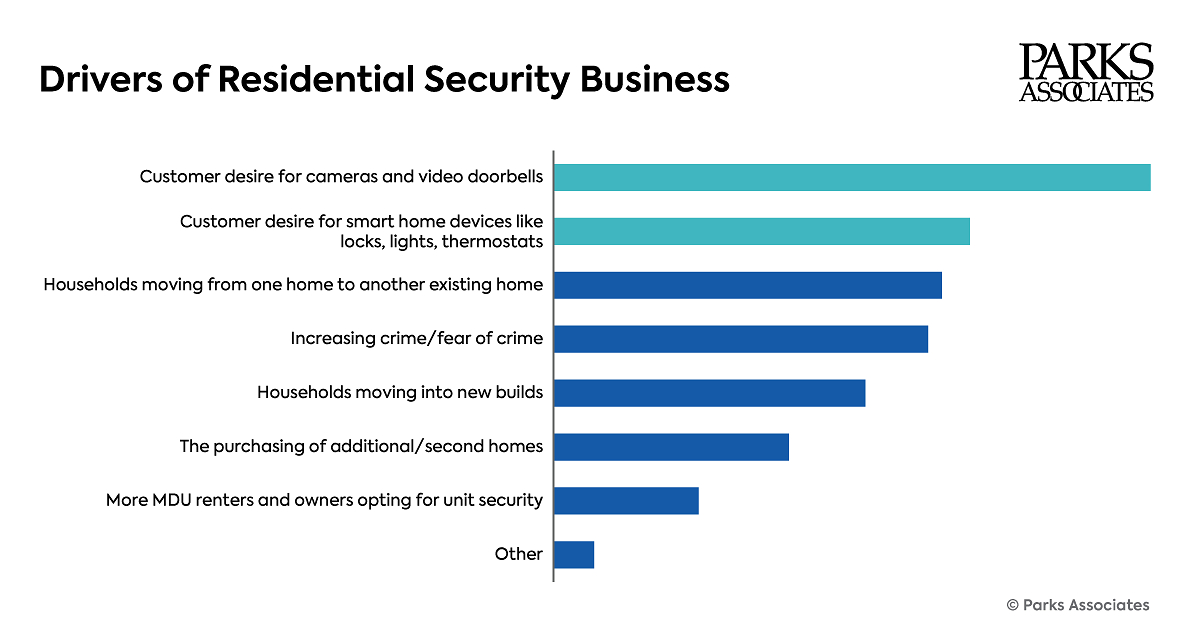
Parks Associates reports interoperability is worsening for US security dealers: 57% say integrating customer-owned smart home devices is difficult (vs. 44% in 2022), as smart device adoption exceeds 50% of internet households. Dealers also face increasing DIY pressure, with 74% reporting lost sales to DIY cameras/video doorbells (up from 51% in 2022-23). The article frames these issues as differentiation opportunities for professional integration and managed connected-home services rather than a sector-wide financial shock.
The economic winner is not the best device maker; it is the platform that can absorb installation complexity and convert it into sticky monitoring and service revenue. That favors security names with strong dealer networks, software layers, and open integrations, because every added device raises switching costs once the home is wired into a managed ecosystem. The corollary is that low-touch DIY channels keep taking unit share, but they also commoditize the first purchase and pressure dealer CAC, so the long-term margin pool may shift away from hardware toward recurring service.
For the listed name, the near-term impact looks too small to underwrite as a standalone catalyst. The real signal will show up in 1-3 quarters via attach rates, churn, and gross margin on service vs installation; if those metrics do not improve, interoperability is just a cost burden disguised as differentiation. Falsifiers include a sharp improvement in consumer platform standards or a major OEM bundle that makes mixed-brand homes easy without dealer involvement.
Contrarian risk: the market may be overestimating how much consumers pay for professional orchestration. In connected home, the ecosystem owner often captures the economics, not the installer, so Amazon/Google/Apple-style control points can still compress dealer pricing power even as integration demand rises. On the other hand, if a company can prove higher recurring revenue per installed home, the stock could rerate despite weak top-line growth.
AI-powered research, real-time alerts, and portfolio analytics for institutional investors.
Overall Sentiment
neutral
Sentiment Score
-0.05
Ticker Sentiment
