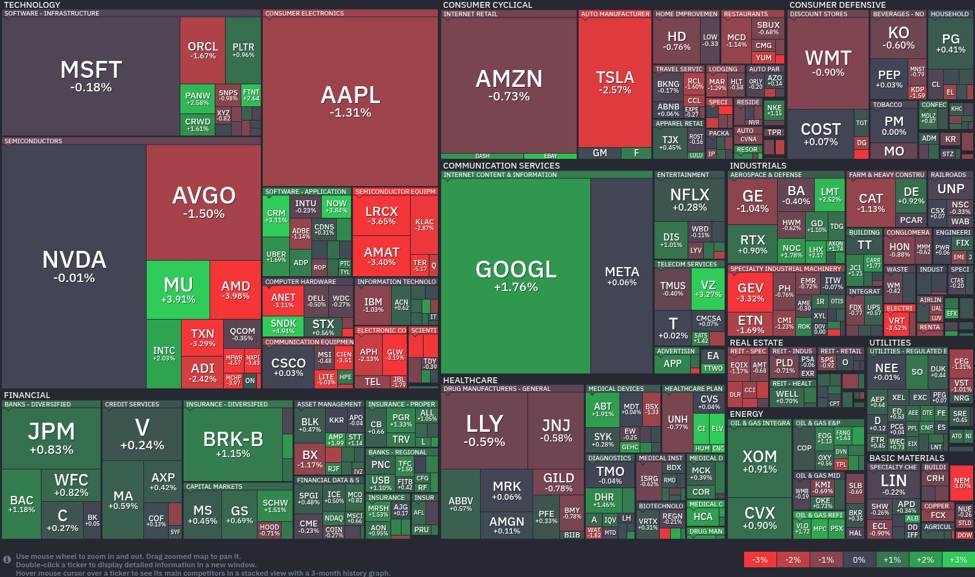
US equities are mixed, with notable sector divergence rather than a clear risk-on or risk-off move. Google rose 1.76% and Micron gained 3.91%, while Apple fell 1.31%, AMD dropped 3.98%, Amazon declined 0.73%, and Tesla slipped 2.57%. Financials were more resilient, with JPMorgan up 0.83% and Bank of America up 1.18%, suggesting selective strength amid broader volatility.
The tape is signaling a dispersion regime, not a clean risk-on or risk-off move. That matters because in these environments the market tends to reward balance-sheet quality and punish anything dependent on multiple expansion, even within the same industry. The strongest second-order read is that capital is rotating toward names with visible near-term cash generation and away from companies whose narratives require either accelerating end-demand or stable long-duration discount rates.
Semis look bifurcated in a way that likely reflects positioning more than fundamentals. The relative strength in memory versus weakness in compute/PC-exposed chips suggests investors are leaning into a later-cycle inventory and pricing recovery while fading capex-sensitive franchises with less immediate earnings visibility. If that spread persists for 2-6 weeks, it can force systematic and long-only rebalancing out of the high-beta winners and into the lower-duration cash generators, amplifying moves beyond what fundamentals justify.
Consumer discretionary weakness is the cleaner macro tell: the market is discounting margin pressure before the data fully confirms it. The risk is that slowing demand shows up first in high-ticket, finance-dependent categories, then leaks into suppliers, logistics, and ad spend, creating a second-round earnings drag across retailers and platforms. Financials holding up suggests the market is not yet pricing a credit event; that leaves room for a tactical long there as a hedge against a soft-growth scare rather than a deep recession bet.
The contrarian opportunity is that the current divergence may be too narrow and too sentiment-driven to last if macro data merely avoids downside surprise. In particular, the most crowded bearish expressions are the consumer and high-multiple tech names, while the market is underappreciating how quickly a benign rates/data sequence can re-rate the most hated large caps. The best risk/reward is to fade the extremes rather than make an outright market call.
AI-powered research, real-time alerts, and portfolio analytics for institutional investors.
Request DemoOverall Sentiment
neutral
Sentiment Score
-0.05
Ticker Sentiment
