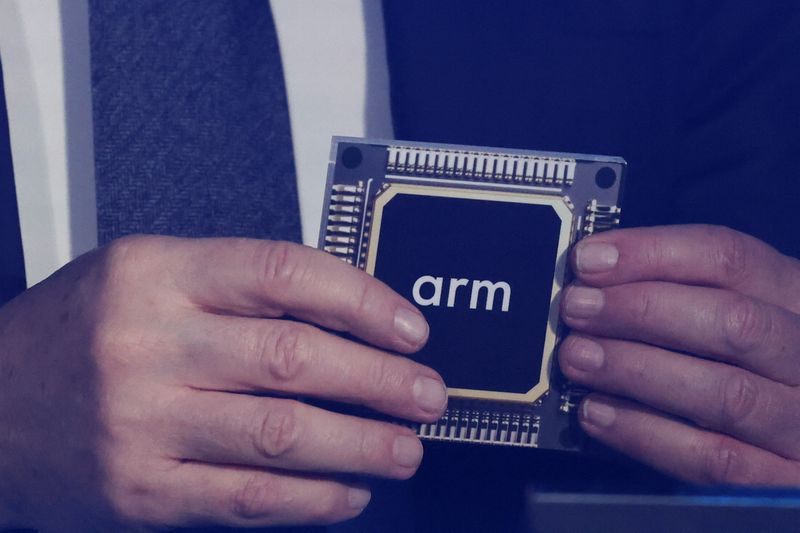
Arm reported adjusted Q4 fiscal 2026 earnings of 60 cents per share on revenue of $1.49 billion, topping consensus of 58 cents and $1.47 billion. Management guided Q1 fiscal 2027 adjusted EPS to 40 cents plus or minus 4 cents and revenue to $1.26 billion plus or minus $50 million, slightly ahead of the $1.25 billion revenue estimate. The stock rose more than 10% after hours, helped by continued AI-related demand and the company’s push into AI data center CPUs, including its new Arm AGI CPU.
Arm’s beat is less important than the signal it sends to the rest of the AI stack: inference demand is still broadening, but pricing power is shifting upstream toward those with control of the compute architecture. For QCOM/AAPL/MSFT/GOOGL/META, the immediate read-through is not direct revenue acceleration; it is a higher probability that platform owners lean harder into custom silicon and tighter vertical integration to reduce dependency on merchant chips and preserve gross margin as AI workloads scale.
The second-order effect is on the semiconductor supply chain. A stronger Arm creates incremental competitive pressure on x86 incumbents and merchant silicon vendors, but the bigger risk is that hyperscalers use Arm-based designs to commoditize parts of the value chain, compressing royalty-like economics over time even as unit volumes rise. That favors companies with differentiated software, systems integration, or captive demand; it is more ambiguous for names that rely on broad ecosystem licensing and third-party design wins.
The market is likely underestimating the lag between positive AI capex commentary and actual monetization. Over the next 1-2 quarters, the trade is sentiment and positioning; over 12-24 months, the key variable is whether Arm’s expansion into silicon becomes margin-accretive or dilutive. If productization accelerates, it can also create channel conflict with customers who prefer Arm as a neutral platform, which could cap multiple expansion despite strong top-line growth.
Contrarianly, this is not an unambiguous bullish signal for the whole chip complex. The consensus is treating AI-related beats as uniformly positive, but a stronger Arm can intensify ecosystem competition and push customers toward in-house designs, which may ultimately reduce addressable royalty intensity. That argues for selective exposure to platform beneficiaries rather than a blanket long on semiconductor beta.
AI-powered research, real-time alerts, and portfolio analytics for institutional investors.
Request DemoOverall Sentiment
moderately positive
Sentiment Score
0.62
Ticker Sentiment
