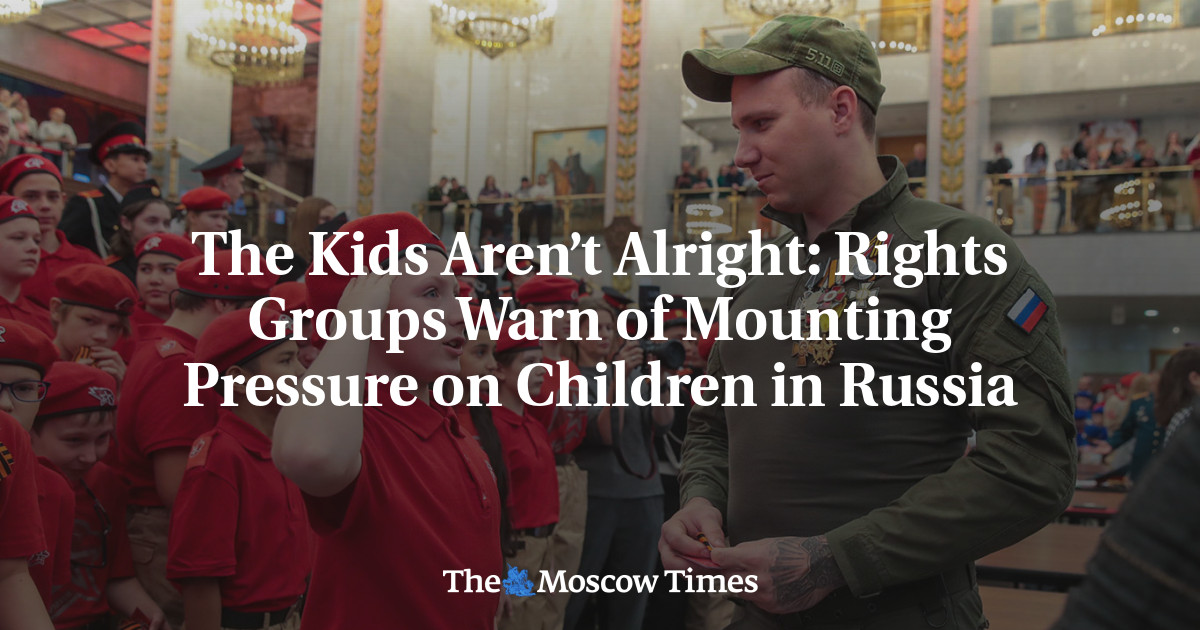
The article describes escalating state pressure on Russian minors, including ideological indoctrination in schools, militarization of education, and increased criminal prosecution of children amid the war in Ukraine. Amnesty International says the education system is being used to promote pro-war narratives, while Memorial says at least 124 children and teenagers are currently being persecuted on political grounds, including 107 imprisoned. It also cites 356 minors added to Russia's terrorists and extremists register in 2025, a twelvefold increase versus 2021.
The investment implication is less about direct asset exposure and more about regime reinforcement: a state that leans harder on coercion, militarized education, and juvenile prosecutions is signaling longer-duration political control at the expense of human capital. That usually supports near-term social stability optics, but it raises medium-term productivity drag, emigration pressure among educated families, and a deeper discount on any asset tied to domestic consumption or private-sector dynamism. The second-order effect is a stronger security-state allocation of fiscal resources, which crowds out civilian capex and keeps the war economy sticky even if battlefield intensity fluctuates.
The more actionable read is on defense-adjacent and sanctions-sensitive flows. A system that embeds drones and wartime training into schools implies a wider domestic pipeline for low-cost unmanned systems, electronics, and dual-use software; that benefits incumbent military procurement networks and state-connected tech contractors, but it also increases the probability of export controls tightening on chips, sensors, and industrial software. The market is likely underpricing the persistence of this industrial mobilization because it looks like education policy on the surface, when it is actually labor-force conditioning for a protracted war footing.
The political prosecution angle is a tail risk for any asset with Ukraine exposure because it increases the odds that negotiations remain performative rather than substantive. In the next 3-12 months, the main catalyst to reverse this trend would be a material fiscal squeeze or elite split that forces a rhetoric reset; absent that, the base case is escalating repression with episodic headline risk. Contrarian view: some investors may already assume maximal repression, but the underappreciated part is the slow-burn impact on demographics and internal security costs, which can compound for years without generating a clean market event.
AI-powered research, real-time alerts, and portfolio analytics for institutional investors.
Request TrialOverall Sentiment
strongly negative
Sentiment Score
-0.75
