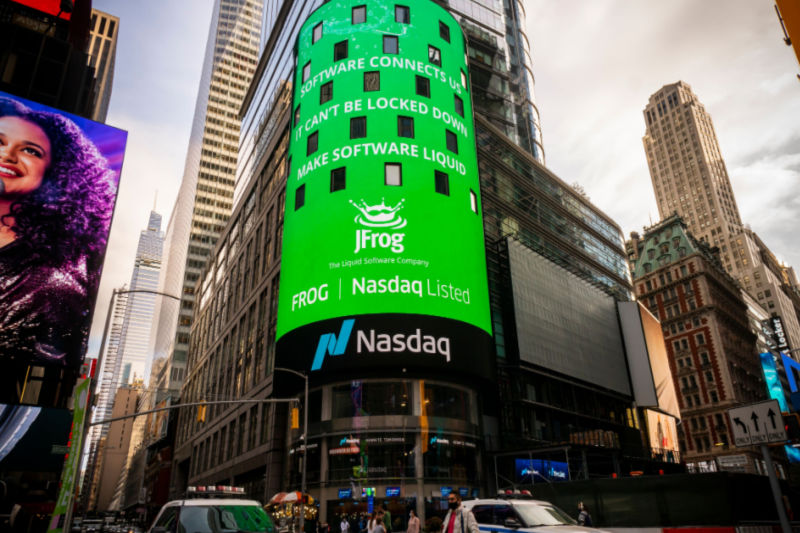
Guggenheim reiterated a Buy rating on JFrog with a $60 price target, citing continued cloud revenue growth and expecting Q1 FY2026 cloud growth to hold near 42% or accelerate. The firm sees total revenue of $152 million, up 24% and 3% above consensus, with non-GAAP operating margin near 20% versus 17.3% expected, and possible FY guidance raised by 100 bps to 18%-19% revenue growth. While Anthropic/OpenAI cyber-model advances are a risk, Guggenheim argues JFrog remains well positioned in artifact governance and security.
The important read-through is not just that one AI hyperscaler is deepening spend, but that the marginal dollar of frontier-model CapEx is now pulling through adjacent software-security vendors faster than the market expected. That creates a second-order demand tailwind for companies that sit in the software supply chain audit path: more generated code means more binaries, more dependencies, and more opportunities for provenance/security enforcement. In that setup, the market tends to underprice the persistence of “security attach” because it looks like an event-driven boost when it is actually a compounding workflow change.
For FROG specifically, the near-term debate is less about whether AI copilots hurt code-quality control and more about who owns the system of record when enterprises start mandating artifact governance. If frontier labs’ binary-reverse-engineering tools remain preview-only, they are more of a narrative overhang than an actual displacement threat over the next 6-12 months; the real risk is procurement teams pausing incremental spend while they evaluate native model capabilities. That creates a classic timing mismatch: headline threat now, revenue substitution later.
The contrarian angle is that consensus may be too anchored to top-line acceleration and not enough to margin durability. If cloud/security mix keeps improving, operating leverage could surprise to the upside even if total revenue growth only meets the low end of current bull cases. The flip side is that expectations have moved up quickly; any sign that the security contribution normalizes could compress the multiple even with solid growth, because the stock is increasingly being priced as a security-AI beneficiary rather than a niche DevOps vendor.
AI-powered research, real-time alerts, and portfolio analytics for institutional investors.
Request TrialOverall Sentiment
mildly positive
Sentiment Score
0.35
Ticker Sentiment
