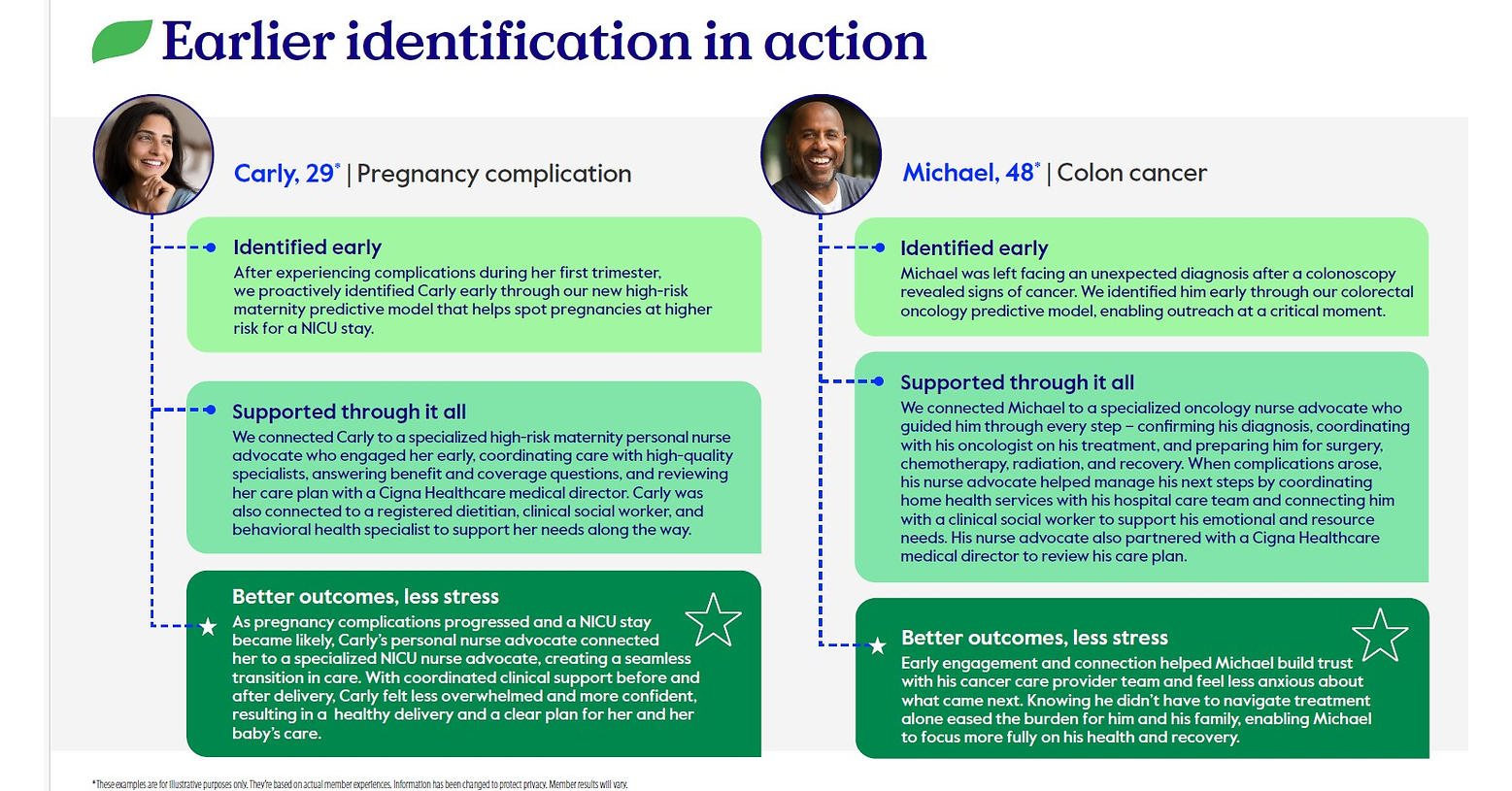
Cigna Healthcare is expanding AI-enabled, predictive clinical care management to support 20% more high-need members, targeting $200M in medical cost savings over three years. For engaged customers, the program targets ~$2,000 per year in reduced medical costs and cites a 42% reduction in avoidable inpatient stays, plus earlier cancer diagnosis identification (breast/colorectal/lung by ~55/46/37 days). The update highlights strong engagement outcomes (95% satisfaction) but is primarily operational, likely limiting immediate market-wide impact.
This reads more like a margin-defense signal than a growth inflection. In managed care, incremental improvements in early intervention can matter disproportionately if they reduce high-cost admissions and ED leakage, but the economic value is often recycled at renewal through lower premiums unless management can keep a larger share of the savings. For CI, the near-term upside is less about the headline savings and more about de-risking medical cost trend, which should help sentiment around earnings durability and suppress multiple discounting versus peers.
The second-order losers are hospitals, acute care utilization, and some specialty/pharmacy spend if earlier navigation shifts patients to lower-acuity settings. Among public comps, HUM and ELV are the most relevant comparison set because investors will ask whether their own care management tools are equally effective; any gap in trend control could become a valuation spread over the next 1-3 quarters. The AI angle is real only if it lowers clinician cost per successful outreach and improves conversion rates; otherwise it is just a branding layer on a familiar utilization-management playbook.
Contrarian view: the market may overreact to the dollar amount, which is modest relative to CI's overall earnings base and could simply reflect a program already partly embedded in pricing. The key falsifier is not the press release but the next two earnings prints: if medical cost ratio, per-member trend, or engagement rates do not improve, the stock should give back any AI premium quickly. Over 6-18 months, the thesis strengthens only if CI shows the program consistently improves retention and bids without sacrificing margin.
AI-powered research, real-time alerts, and portfolio analytics for institutional investors.
Request DemoOverall Sentiment
moderately positive
Sentiment Score
0.35
Ticker Sentiment
