
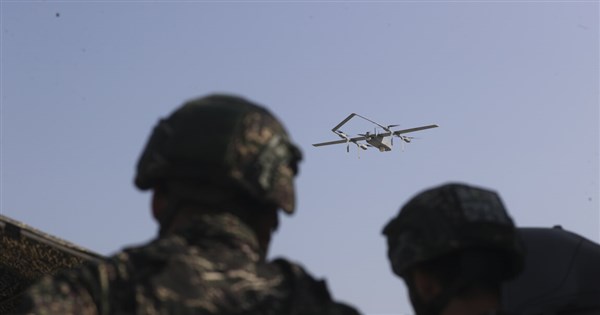
The article warns that cheap drone attacks can force defenders to expend multimillion-dollar interceptor missiles, with U.S. and Gulf PAC-2/PAC-3 inventories projected to run low by late April and mid-June, respectively. It highlights Taiwan’s vulnerability to a potential Chinese drone-saturation strategy and argues for more cost-effective counter-UAS systems such as mobile guns, jammers, and compact interceptors. The core takeaway is a defense-cost imbalance that could strain Taiwan’s air-defense readiness in a cross-strait conflict.
The market implication is not the headline geopolitical risk; it is the forced re-prioritization of defense budgets toward cheap, saturating threats. That shifts spending mix away from exquisite interceptors and toward layered, high-volume counter-UAS systems, which is structurally favorable for suppliers of mobile air defense, radar, electronic warfare, and battle-management software. DRS stands out because the incremental dollars are likely to flow first into integration-heavy, vehicle-mounted air defense packages rather than standalone missile defense, and that budget reallocation can persist for years once militaries internalize the cost-exchange problem.
Second-order winners are the firms that can sell “good enough” volume at lower unit economics: gun-based C-UAS, jamming, sensors, and command-and-control. The overlooked beneficiary is the integration layer, not the interceptor itself, because militaries will want a common architecture that can fuse guns, rockets, EW, and short-range missiles into a single mobile shield around command nodes and high-value assets. That favors platforms with existing defense relationships and software-defined upgrade paths, while pure-play missile suppliers face a relative mix drag if procurement dollars are diverted to cheaper alternatives.
The risk is timing. In the next 1-3 months, budget commentary and procurement announcements can lag the operational lesson, so the stock reaction may be slower than the strategic need. The nearer-term upside catalyst is any documented depletion of interceptor inventories or additional drone-saturation events, which would validate the thesis and compress procurement timelines. The contrarian view is that this can become a narrative trade if decision-makers keep buying the same high-end interceptors anyway; however, that would imply a politically unsustainable cost curve, so the more likely outcome is a gradual but persistent shift in capex toward layered, lower-cost defenses.
DRS is the cleanest ticker expression here because it sits in the integration and mission-systems bucket that benefits from the doctrine shift without needing a single headline program win. The main uncertainty is valuation already embedding some defense upcycle, so the better entry is on pullbacks or after evidence of follow-on C-UAS orders rather than on the article alone.
AI-powered research, real-time alerts, and portfolio analytics for institutional investors.
Request TrialOverall Sentiment
mildly negative
Sentiment Score
-0.35
Ticker Sentiment
