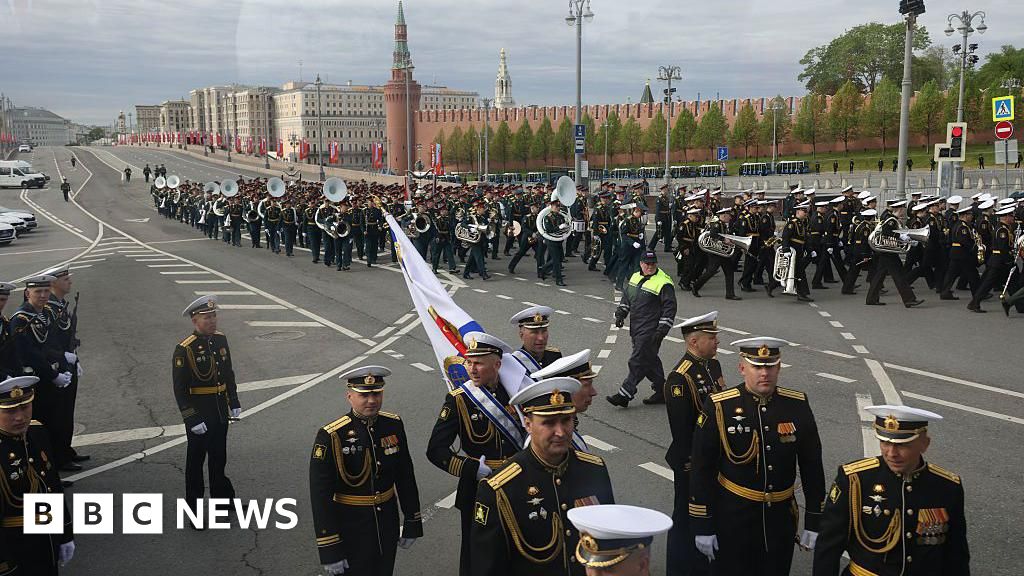
Russia's 2026 Victory Day parade in Moscow was scaled back, with no tanks, rocket launchers, or intercontinental ballistic missiles on display and fewer journalists, guests, and foreign leaders in attendance. Authorities cited security concerns tied to possible Ukrainian drone threats, and a last-minute ceasefire brokered by Donald Trump helped the event pass without incident. The article underscores the ongoing war in Ukraine and Moscow's effort to project strength despite visible limitations.
The parade’s visible downgrade is less about optics than it is about Kremlin risk management under constraint. When a state that relies on spectacle to signal escalation capacity can no longer safely stage heavy hardware in the capital, it hints at a widening gap between narrative strength and operational freedom; that usually matters most for assets exposed to sanctions enforcement, logistics bottlenecks, and war-duration assumptions rather than for headline geopolitics alone.
Second-order effect: the shift from physical display to video projection is a subtle admission that domestic propaganda can substitute for persuasion, but only partially. If Moscow increasingly leans on symbolic messaging while avoiding concentration of valuable assets in one place, it implies higher force dispersion and more decentralized security spending over the next 3-12 months, which is supportive for companies tied to counter-UAS, perimeter defense, secure communications, and military transport, while being mildly negative for any optimism around a near-term negotiated settlement.
The market takeaway is that this is not a victory signal; it is a resilience signal. The more the war is managed through temporary ceasefires and staged symbolism, the more the base case shifts toward a prolonged attritional conflict with intermittent de-escalation windows, which tends to compress volatility in the very short term but extends the tail risk of renewed escalation into summer and autumn. The main contrarian miss is that investors may overweight the ceasefire as durable; the more likely outcome is a pause in headline risk, not a structural reduction in defense demand or geopolitical risk premia.
For positioning, the setup favors owning beneficiaries of prolonged drone/counter-drone spend and avoiding names dependent on an imminent peace dividend. The broader defense trade is less attractive here than the niche layer of infrastructure hardening and electronic warfare, where budget shifts can accelerate even without a formal war escalation. If the conflict remains frozen-but-active, the market should continue to reward supply-chain redundancy and homeland security over raw offensive platforms.
AI-powered research, real-time alerts, and portfolio analytics for institutional investors.
Request DemoOverall Sentiment
neutral
Sentiment Score
-0.10
