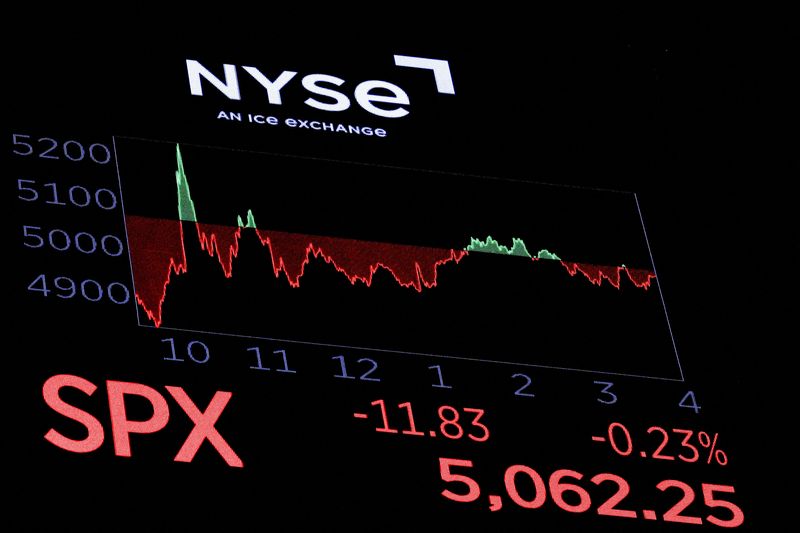
Berkshire Hathaway reported an 18% jump in Q1 profit, while its cash pile is nearing $400 billion. Broader market commentary is constructive: AI-driven inflows totaled $86 billion in April, US equities are attracting the bulk of global capital, and positioning remains below historic extremes, leaving room for further upside. The article also notes stronger demand for US semiconductors, dollar strength, and continued caution in bonds amid inflation and debt concerns.
The most important read-through is not “risk-on” in the abstract; it is that the market is becoming more self-referential. When flows, benchmark chasing, and AI-linked momentum dominate price discovery, leadership narrows and the marginal buyer becomes less price-sensitive. That tends to favor the highest-quality balance-sheet compounders and a handful of narrative names, while lower-quality cyclicals and non-US exposures can lag even if fundamentals are merely stable.
Berkshire’s cash mountain is a signal of optionality, not inactivity. In a regime where dispersion is rising and correlations are falling, large capital allocators with dry powder become latent volatility dampeners: they can step in during drawdowns, but more importantly they can force re-pricing in specific pockets if they deploy into dislocated high-quality names. The second-order effect is that market participants will over-interpret any Berkshire deployment into a security as a validation trade, compressing entry windows for others.
For the AI complex, the setup is still constructive but increasingly binary into earnings. The trade has shifted from “AI beneficiaries” to “AI monetization proof,” which means guidance on capex efficiency, customer concentration, and margin durability matters more than headline demand. If those names disappoint even modestly, the crowded positioning and crowded retail call buying can unwind quickly over a 2-6 week horizon, particularly in names with elevated expectations and thin fundamental anchors.
The contrarian miss is that broad equity strength can coexist with a fragile market underneath. A strong dollar and emerging-market capital flight imply tightening global financial conditions outside the US, which eventually feeds back into multinationals, commodity demand, and credit-sensitive sectors. The rally is probably overextended in duration, not necessarily in price yet; the risk is a late-cycle melt-up that leaves very asymmetric downside once earnings breadth fails to confirm.
AI-powered research, real-time alerts, and portfolio analytics for institutional investors.
Request DemoOverall Sentiment
mildly positive
Sentiment Score
0.35
Ticker Sentiment
