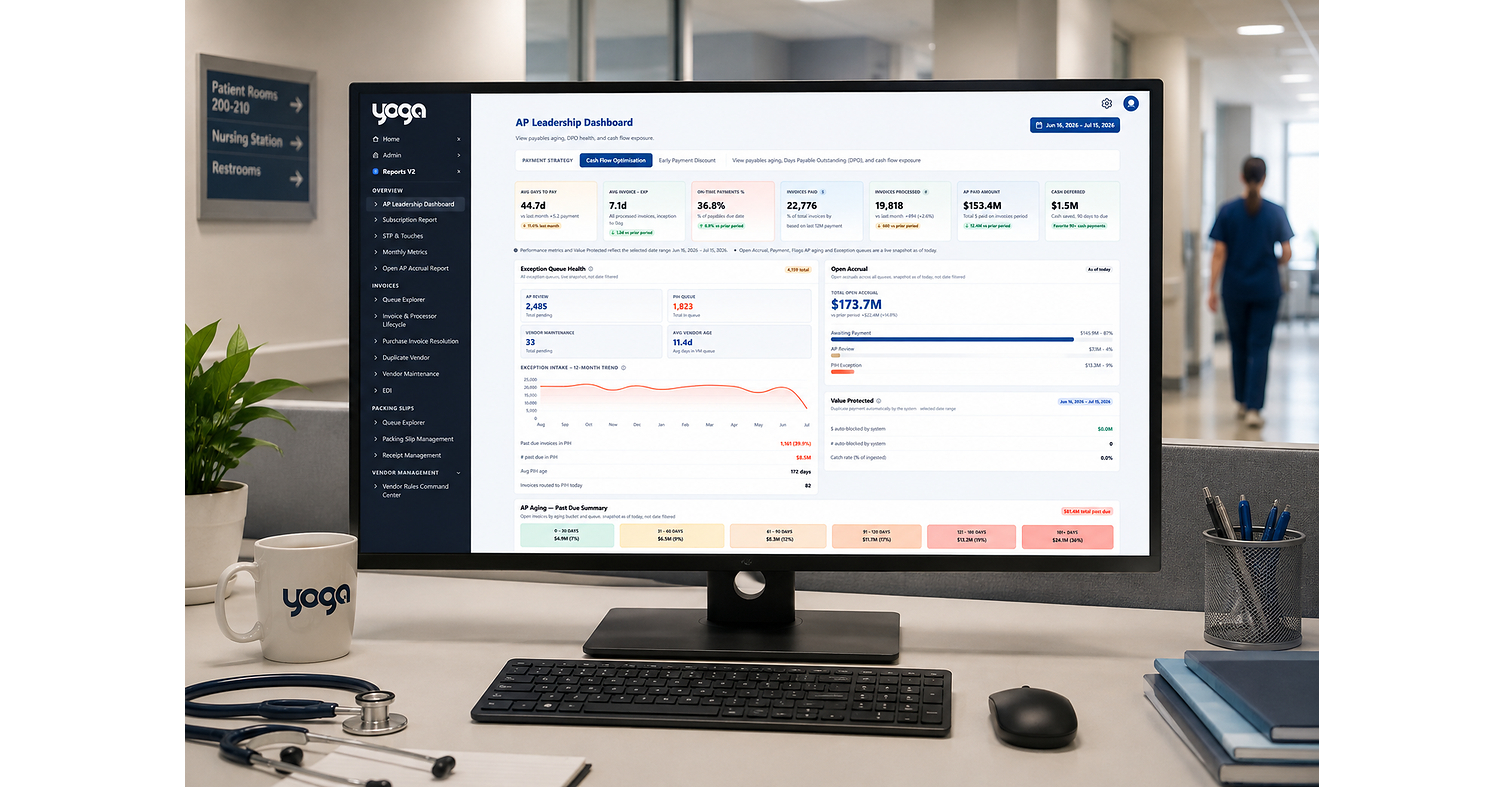
RPI Consultants announced a complete overhaul of reporting in its Yoga Flexible Software, delivering end-to-end visibility across the accounts payable (AP) process—from high-level summaries to line-item detail. The redesign adds live views of what’s due/past due, automated-discount tracking for capturable dollars, duplicate-invoice detection to flag money leaks, and full invoice routing history to pinpoint bottlenecks. The upgrade is positioned as a response to a May 2026 KLAS Research Emerging Insights review that highlighted reporting as an improvement area, and the new suite is available now for all Yoga clients.
This reads as a defensive product catch-up, not a new demand vector. The immediate economic benefit is concentrated in the installed base: better AP visibility typically improves renewal stickiness and gives services teams a cleaner upsell story, but it rarely moves the revenue line meaningfully without evidence of higher attach rates or lower churn. The more interesting competitive implication is that embedded ERP workflows keep getting "good enough," which raises the hurdle for standalone AP workflow and reporting vendors that rely on feature gaps to justify premium pricing.
Second-order, the likely winner is the implementation/services layer around ERP modernization, not the software feature itself. If reporting reduces manual exception handling and month-end close friction, clients may re-prioritize spend toward broader process redesign rather than point tools, which can benefit large ERP ecosystems and hurt niche workflow vendors over a 6-18 month horizon. The flip side is that richer visibility also makes ROI easier to benchmark; if the promised savings do not show up in audit trails, duplicate-invoice recovery, or discount capture, the feature becomes table stakes rather than a differentiator.
The catalyst path is weak unless management can show measurable adoption metrics: lower invoice cycle times, higher discount realization, or better retention on the next renewal cohort. Near term, the market should treat this as noise; over 1-3 quarters, it matters only if customer references translate into larger deals or better KLAS positioning. Contrarian view: consensus may overrate the strategic significance of a press-release fix to a known weakness — the move is probably underwhelming relative to the PR tone, and the burden of proof is still on operating data rather than product narrative.
AI-powered research, real-time alerts, and portfolio analytics for institutional investors.
Request DemoOverall Sentiment
mildly positive
Sentiment Score
0.15
