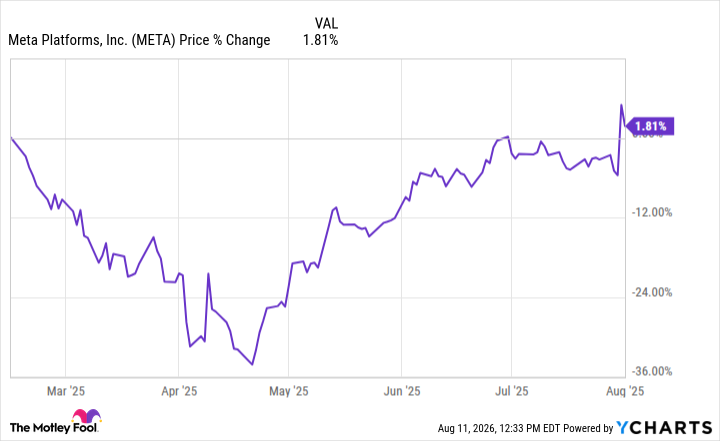
Meta stock is down ~27% from its recent high as AI-related spending pressures margins, profits, and free cash flow, while a judge ruling allows thousands of lawsuits over allegedly addictive social-media design to proceed. Offsetting this, the article cites evidence that Meta’s AI initiatives are improving engagement and streamlining ad launches, and it suggests Meta may consider renting excess AI compute via a cloud business. Valuation is framed as reasonable at ~19.9x forward earnings vs ~21.4x for IT peers, implying potential upside if AI ROI improves and regulatory outcomes prove less damaging than feared.
The key market question is not whether Meta is a quality franchise; it is whether management can convert the current AI spend wave into a visible ROIC inflection before the market loses patience. In the next 1-3 quarters, the stock trades less on user growth than on whether operating leverage reappears after depreciation, compute, and headcount expansion. If that inflection does not show up, the apparent valuation support can still compress further because the market will discount “strategic investment” as permanent margin dilution.
Second-order beneficiaries are the AI infrastructure chain, not necessarily Meta itself. Continued capex supports demand for accelerators, networking, and data-center plumbing, which keeps NVDA and the broader SMH complex insulated even if Meta equity underperforms; the spend is a revenue tailwind upstream regardless of near-term shareholder returns. By contrast, smaller ad platforms like SNAP and PINS are vulnerable if Meta’s AI tools keep improving advertiser ROI and creative automation, because budget dollars tend to migrate to the platform with the best measured conversion economics.
The contrarian miss is on legal duration risk: this looks less like a one-off headline and more like a multi-quarter overhang that can cap the multiple even if the business stays healthy. The stock can absolutely mean-revert, but the better falsifier is not history; it is the next earnings print and capex guide. If FCF margin does not stabilize and litigation advances toward remedies or behavior changes, the rebound thesis becomes a lower-conviction trade rather than a structural buy.
AI-powered research, real-time alerts, and portfolio analytics for institutional investors.
Request DemoOverall Sentiment
mixed
Sentiment Score
-0.10
Ticker Sentiment
