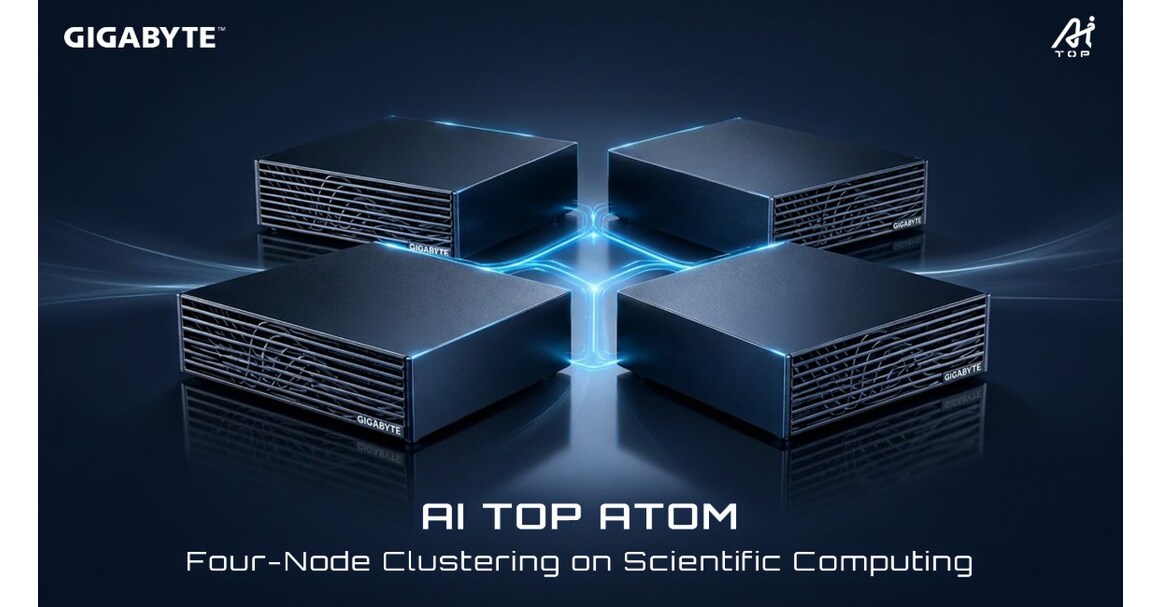
GIGABYTE showcased an AI TOP ATOM 4-node clustering setup for scientific simulations, scaling from single-system limits to >30M atoms in IC-packaging research (vs ~10M atoms typically on standalone systems). Each node delivers up to 1 PFLOP FP4 AI performance with 128GB unified memory, linked via a RoCE 200GbE switch, enabling memory-intensive workloads beyond one machine. The demo, developed with NVIDIA using NemoClaw blueprints and the Nemotron-3-Nano-30B model, couples AI-driven hypothesis generation with GROMACS simulations for thermal interface material development.
This is a validation event for NVIDIA’s ecosystem more than a near-term revenue inflection. The mechanism that matters is not the workstation itself, but that multi-node local clusters require the same software stack, networking discipline, and memory architecture that keep customers tied to NVIDIA’s platform once they move beyond toy workloads. That supports a longer adoption curve for enterprise/industrial AI, but the first-order dollar impact is still small relative to data center spend.
The likely winners are system builders and high-speed networking vendors that can monetize “cluster-ification” of on-prem AI; the risk is that a portion of experimental compute shifts away from cloud GPUs, but that is more a mix shift than a demand destruction story. The more interesting second-order effect is in scientific and industrial R&D: if materials, pharma, and semiconductor packaging teams can iterate locally, they may justify incremental accelerator purchases that were previously cloud-rented, extending the replacement cycle for compute rather than compressing it.
This is a press-release-driven signal, so the burden of proof is on follow-through in channel checks and earnings commentary over the next 1-3 months. Falsifier: if NVIDIA’s next disclosures still show growth concentrated in hyperscalers with no evidence of enterprise cluster attach, then this is marketing rather than monetizable demand. The contrarian view is that the market may underappreciate how local clusters broaden the buyer base; the consensus likely overstates immediate revenue while understating the durability of platform lock-in over 6-18 months.
AI-powered research, real-time alerts, and portfolio analytics for institutional investors.
Overall Sentiment
mildly positive
Sentiment Score
0.15
Ticker Sentiment
