
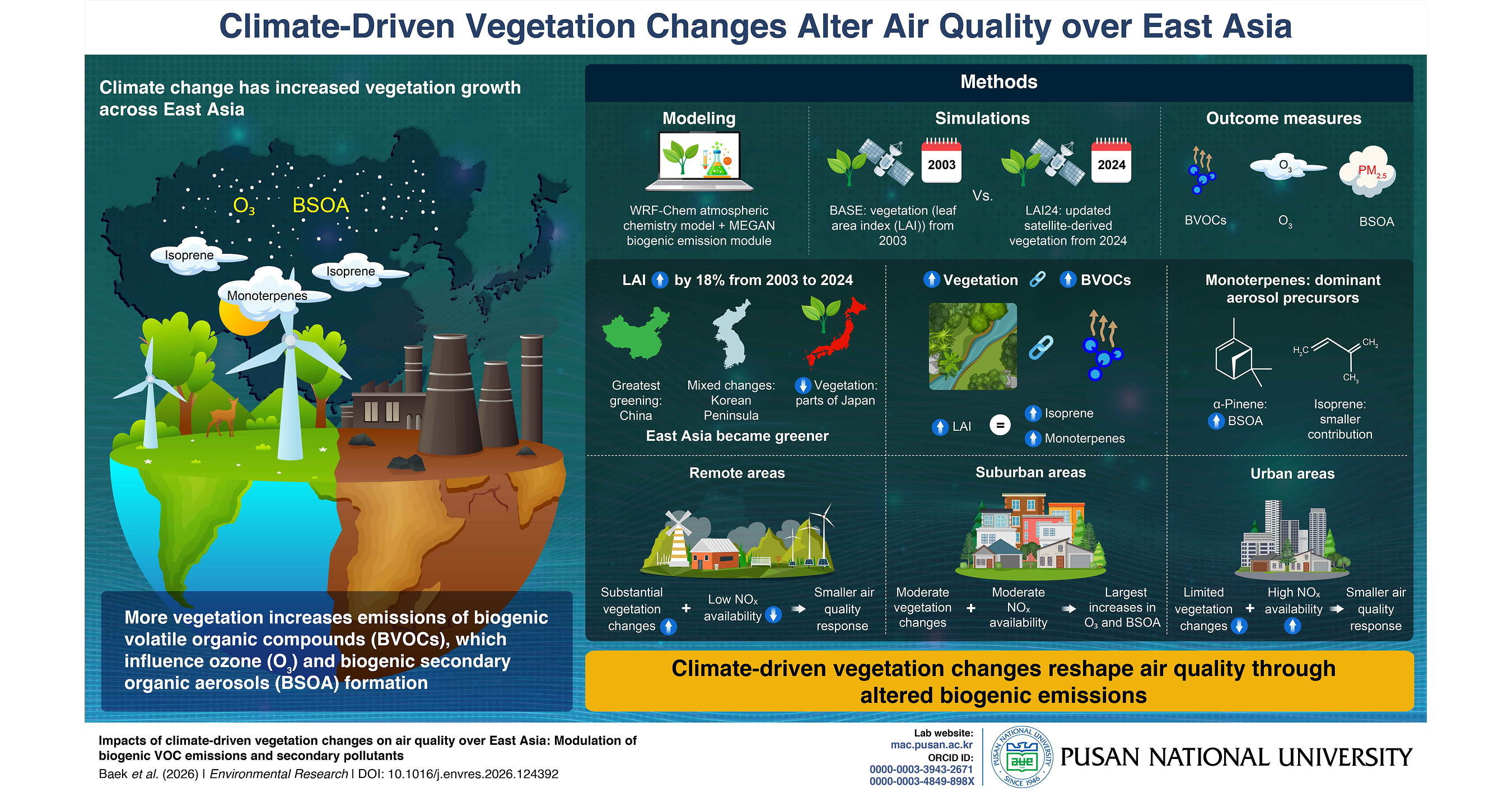
A Pusan National University study finds climate-driven vegetation greening across East Asia can materially change modeled air pollution by updating biogenic emissions inputs from 2003 to satellite-derived 2024 vegetation. Using WRF-Chem with the MEGAN biogenic emissions module, the authors report that the updated vegetation dataset significantly alters estimated ozone (O3) and biogenic secondary organic aerosols (BSOA), with the largest increases in suburban areas. The work suggests regularly refreshing vegetation datasets via satellites can improve atmospheric chemistry modeling and more reliable air quality forecasting, though it is primarily academic and not presented as an immediate commercial or policy trigger.
This is not a direct equity catalyst so much as a modeling-and-policy catalyst: if regulators and forecasters start using current vegetation states, ozone risk is likely to be revised upward first in suburban belts where NOx is present but previously under-modeled biogenic VOCs were ignored. The market implication is modest near term, but it points to a gradual increase in compliance spending for industrial emitters, urban infrastructure, and air-quality analytics across Korea, Japan, and coastal China.
The first beneficiaries are not the forest or climate names; they are the firms selling measurement, controls, and process optimization that help customers prove emissions compliance. Think environmental instrumentation, industrial automation, and stack-monitoring vendors rather than broad ESG baskets. If this gets folded into operational forecasting, it can also create a niche demand tailwind for satellite/data providers and modelers, but that is a 6-18 month adoption story, not a day-one trade.
Contrarian view: the market should not extrapolate a paper into a regime change. This only says the model baseline was stale; it does not prove a step-change in measured health outcomes or trigger immediate capex. The real falsifier is policy inertia: if summer ozone readings and local rulemaking do not tighten over the next 1-2 air-pollution seasons, the investment case for the adjacent industrial-environmental basket fades quickly.
AI-powered research, real-time alerts, and portfolio analytics for institutional investors.
Request TrialOverall Sentiment
neutral
Sentiment Score
0.05
Ticker Sentiment
