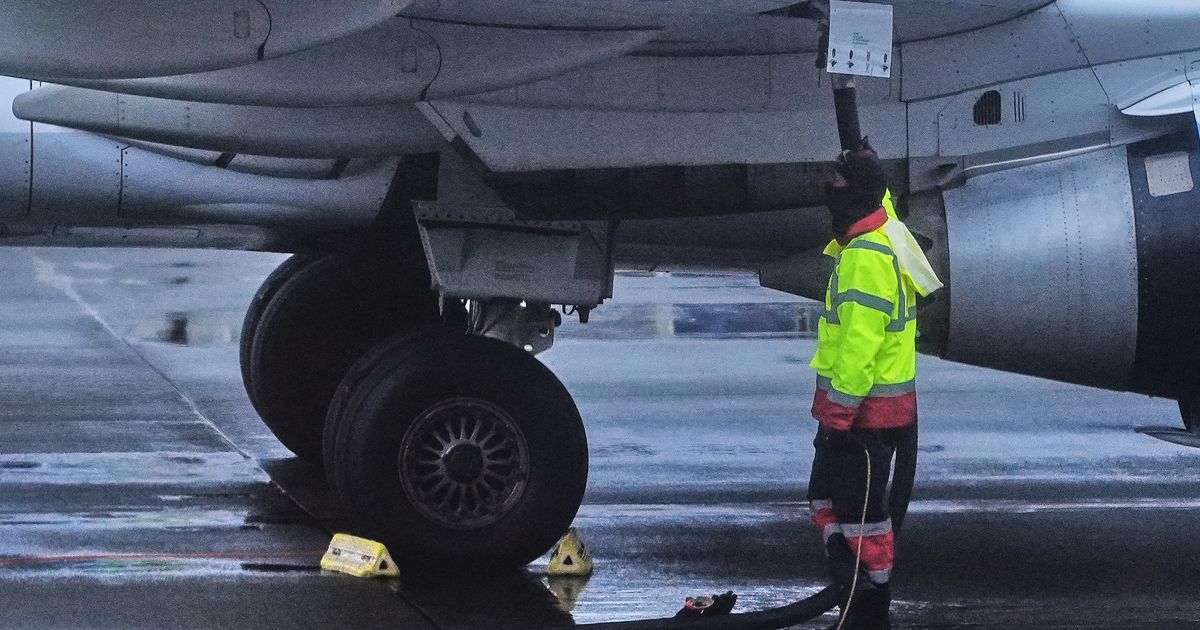
Jet fuel averaged $3.99/gal in the U.S. after the Middle East conflict — up from $2.50 two weeks earlier (≈+60%) and well above the $2.36/gal January level — putting immediate cost pressure on airlines. Fuel represents roughly 20–25% of airline operating costs, so sustained higher prices and longer routings from airspace closures are likely to drive fare increases, fuel surcharges (e.g., Air France-KLM ~€50 roundtrip, Air India up to $50), and potential route/schedule adjustments, with larger impacts on long-haul international services. Airlines with partial hedges may be protected short-term, but carriers without hedges face margin risk if elevated prices persist.
The immediate profit impact will be uneven: carriers whose network mixes skew to long-range, widebody flying face a magnified per-ASM fuel shock versus dense domestic operators, and this gap can widen through route rationalization rather than uniform fare increases. Our scenario models a 50–70% short-term uptick in jet-kerosene pricing translating to a ~10–18% rise in CASM for long-haul-heavy carriers versus ~5–9% for point-to-point domestic-focused peers, before any revenue actions. Hedging books create a multi-month stagger: balance sheets with significant rolled hedges will see headline protection initially but larger negative surprises later as hedges roll off and crack-spread exposure bites refiners’ pass-through.
Second-order winners include cargo-focused operators and integrators whose yields often reset faster than passenger fares; expect belly-freight scarcity on widebodies to push premium cargo yields higher and partially offset passenger erosion for mixed carriers. Conversely, used values for older, less fuel-efficient widebodies become a latent impairment risk for lessors and airlines carrying those assets, pressuring residual-value dependent financing lines. Operationally, airspace closures and reroutes amplify block-hour costs and reduce daily aircraft turns—this favors fleets with younger, longer-range narrowbodies that can maintain schedule integrity with fewer excess seats.
Key catalysts and horizons: markets price volatility in days, revenue pass-through in 6–12 weeks as booking curves reprice toward summer, and structural network changes over 6–12 months as airlines retire inefficient frames and reallocate capacity. Reversal events that would compress jet spreads quickly include rapid de-escalation or coordinated strategic petroleum releases and a meaningful uptick in refinery throughput; these can snap option-implied jet volatility lower inside 2–8 weeks. Tail risks: sustained high fuel could trigger demand elasticity shocks (material yield deterioration) into Q4 or force government interventions on international surcharges, creating non-linear downside for equity holders.
Consensus is treating this as a uniform cost shock; it is not. The market underestimates the speed at which ancillary revenue algorithms and capacity reallocation can shore up yields—airlines with modern revenue-management and loyalty leverage will capture a disproportionate share of pass-through. That implies a relative-value bifurcation: short-duration tactical pain for some legacy long-haul networks but asymmetric rebound potential for agile domestic carriers and cargo specialists as pricing mechanisms reoptimize.
AI-powered research, real-time alerts, and portfolio analytics for institutional investors.
Request DemoOverall Sentiment
mildly negative
Sentiment Score
-0.25
Ticker Sentiment
