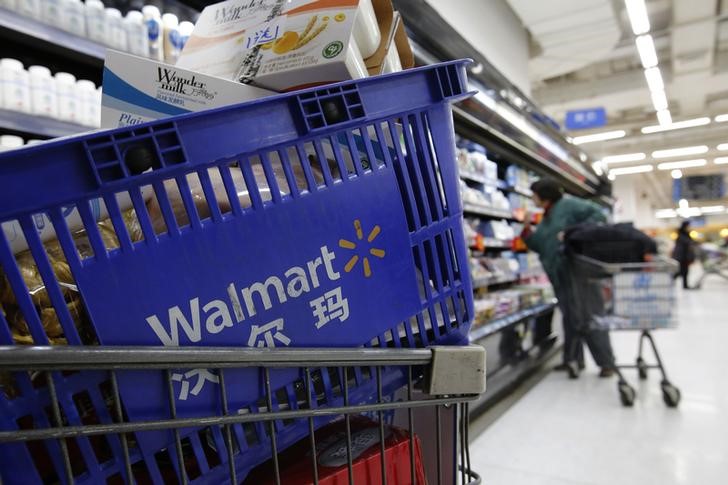
Walmart fell 7.3% after reporting Q1 revenue of $177.8B, above the roughly $174.8B consensus, but issuing weaker-than-expected Q2 adjusted EPS guidance of $0.72-$0.74 versus $0.75 expected. Full-year adjusted EPS guidance of $2.75-$2.85 also missed estimates, with management citing higher fuel costs and consumer pressure from elevated gas prices. The miss came against a risk-off backdrop of rising Treasury yields, surging oil prices, and geopolitical tensions tied to Iran.
The key read-through is not just weaker retail execution; it is that management is signaling margin pressure before the consumer slowdown is fully visible in unit data. That usually matters most for the next 1-2 quarters, when investors are forced to underwrite earnings compression rather than top-line resilience. In a risk-off tape, a guidance miss from a “defensive” winner can de-rate the entire food/discount cohort because it challenges the assumption that traffic quality alone can offset cost inflation.
Kroger is the cleaner second-order loser if Walmart’s pressure is coming from fuel and household budget strain rather than company-specific execution. Grocery tends to absorb trade-down volume early, but if basket inflation cools while wage/freight/fuel costs stay sticky, gross margin leverage disappears quickly. That creates a subtle negative for suppliers as well: private-label and packaged-food vendors may see share gains on volume but lose mix power, which can cap earnings quality across staples.
The most important contrarian point is that the move may still be underdone on the downside if this is the first sign of a broader consumer elasticity reset. Markets have been paying up for defensive retailers as recession hedges; if that hedge stops working, multiple compression can extend beyond one print. On the other hand, if fuel reverses or tax refunds normalize, the stock can stabilize quickly because the core traffic engine is still intact — the issue is margin visibility, not demand destruction.
For Nvidia, the only reason this article matters is as a valuation contrast: money is likely to keep rotating toward perceived secular compounders when cyclical defensives wobble. That creates a near-term bid for high-quality AI beneficiaries, but it also raises the bar for NVDA because capital may chase duration, not fundamentals, for several sessions. If semis hold up while defensives weaken, NVDA can become even more crowded as a relative safe-growth trade, which increases squeeze risk on any minor valuation scare.
AI-powered research, real-time alerts, and portfolio analytics for institutional investors.
Request DemoOverall Sentiment
strongly negative
Sentiment Score
-0.58
Ticker Sentiment
