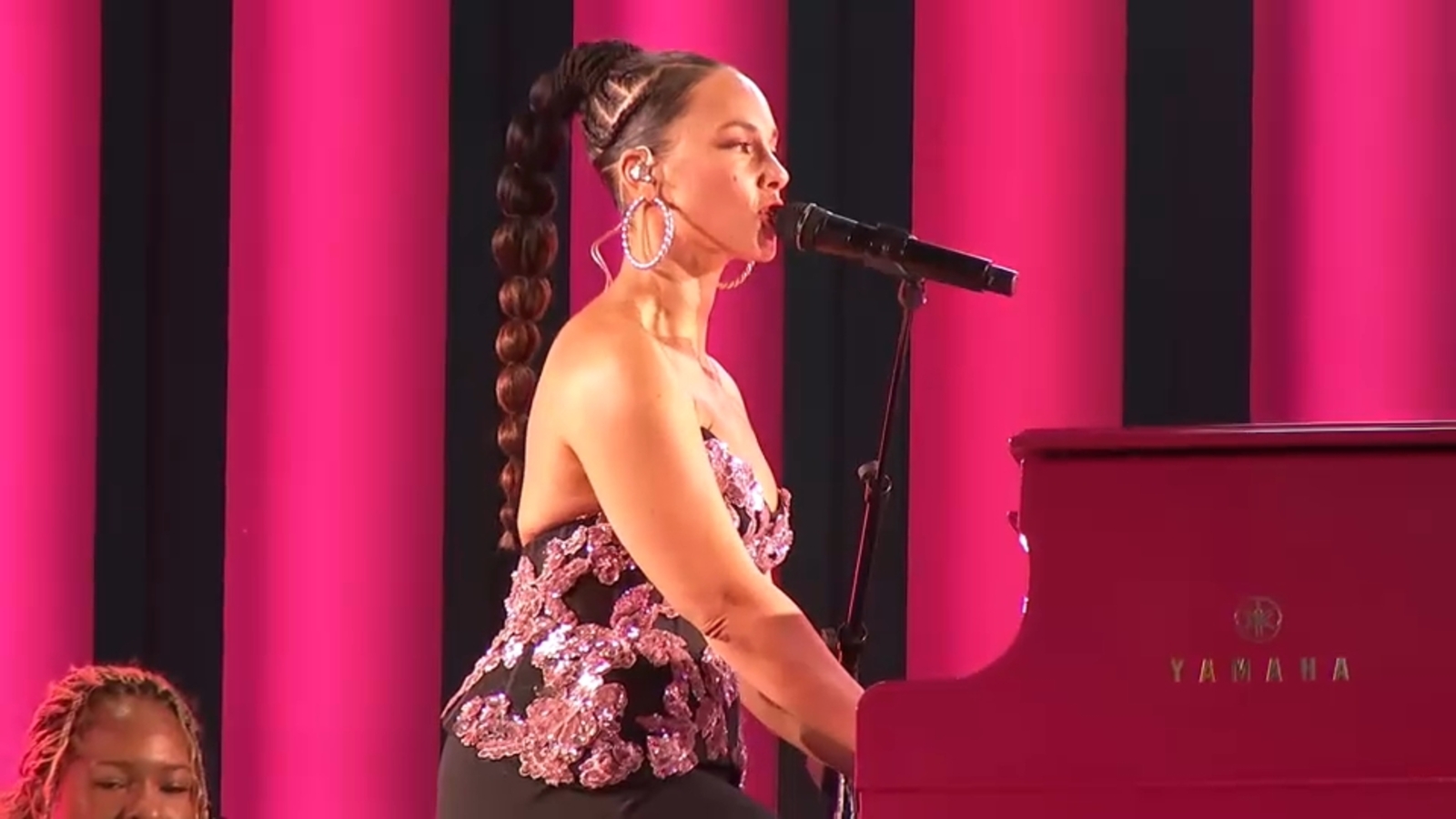
Apple marked its 50th anniversary with an in-store concert at the Grand Central Terminal Apple Store, where Alicia Keys performed hits including 'Fallin'' and 'You Don't Know My Name.' The piece notes Apple was founded April 1, 1976 by Steve Jobs, Steve Wozniak and Ronald Wayne and has since grown into one of the world's largest companies. This is a brand/marketing event with no material financial or market-moving information.
Apple’s use of high-profile in-store experiential marketing functions as a low-cost customer acquisition and engagement channel that translates directly into short-term foot-traffic and attach-rate gains. Empirically, well-executed retail events can lift weekend foot traffic 15–25% and produce a 2–3ppt bump in accessory attach rates over the following 2–4 weeks; for Apple this scales because each incremental device sale compounds Services ARPU over a multi-year customer lifetime.
The second-order lever is Services monetization: higher in-store engagement accelerates trial-to-paid conversion for bundled and media offerings and can shift churn trajectories for a cohort, producing a modest but persistent uplift to Services growth (we’d model a 50–100bp improvement in Services revenue growth over the next 2 quarters for each quarter of sustained retail activation). This is non-linear: incremental engagement is more valuable on the installed base tail where marginal cost of additional revenue is near-zero, so small increases in conversion carry outsized margin impact.
Competitively, Apple retains a unique advantage because it controls the store experience, POS, payments and content distribution — that tight vertical stack amplifies marketing ROI relative to handset OEMs and pure-play streamers, which must rent attention. The losers are those whose customer acquisition is primarily digital and price-sensitive (e.g., ad-supported streamers) and accessory makers without favored in-store placements; mall landlords and premium landlords capture spillover but are exposed to cyclicality in discretionary retail.
Key risks and catalysts: the bump is short-to-medium term (days–months) and can be reversed by macro-driven weakening in discretionary spend, a softening of the iPhone upgrade cycle, or regulatory actions that limit in-store steering toward owned services (months–years). Monitor next two quarterly Services prints and Apple Store traffic metrics (weekend comps) as primary catalysts; a sustained improvement through two consecutive quarters would justify re-rating Services multiple, while a single-quarter fade should trigger tactical profit-taking within 30–60 days.
AI-powered research, real-time alerts, and portfolio analytics for institutional investors.
Request DemoOverall Sentiment
neutral
Sentiment Score
0.00
Ticker Sentiment
