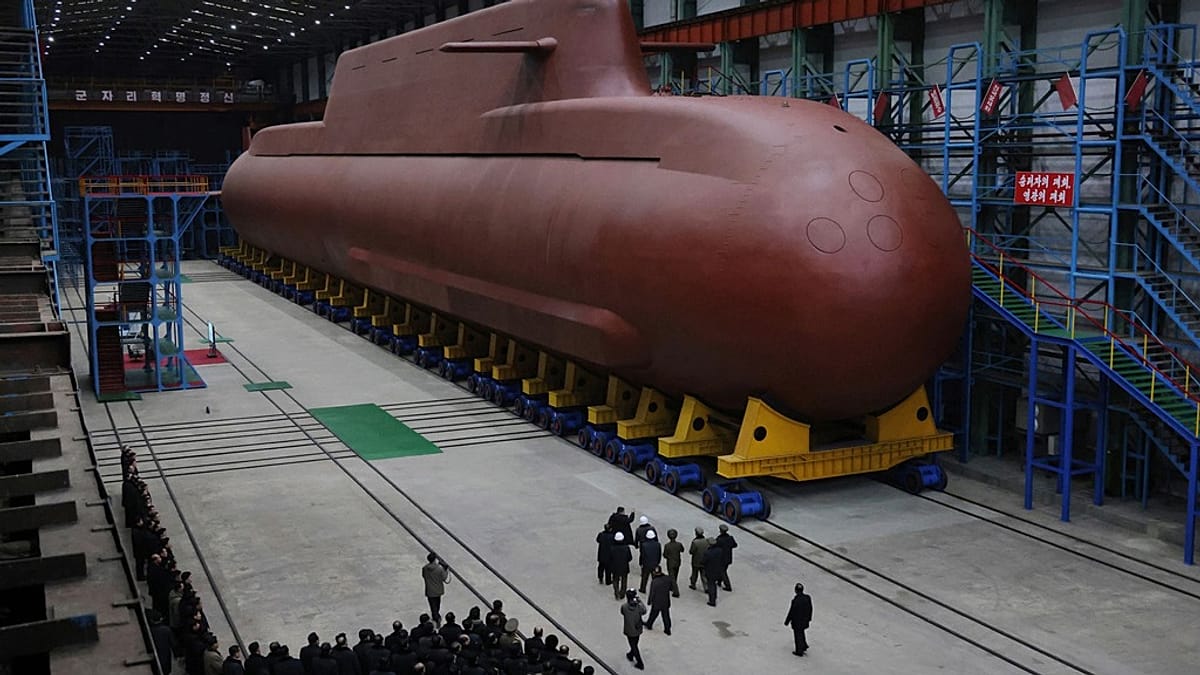
North Korea released images of what state media calls an 8,700-tonne nuclear-propelled submarine hull after leader Kim Jong-un inspected the vessel, describing its completion as an "epoch-making" enhancement to the country's nuclear deterrent. Analysts say the largely completed hull implies core systems, possibly including a reactor, are already installed and sea trials could occur within months, raising regional escalation risks, potential increases in South Korean and US defense cooperation, and questions about possible technology assistance from Russia.
Market structure: A demonstrated push by North Korea to field a nuclear‑powered ballistic/attack submarine increases near‑term demand for ASW (anti‑submarine warfare) sensors, submarine components, and nuclear fuel/enrichment services. Winners are large defense primes (Lockheed Martin LMT, Northrop Grumman NOC, Raytheon RTX), specialist shipbuilders (Huntington Ingalls HII), and uranium/nuclear suppliers (Cameco CCJ, BWXT BWXT, URA ETF); losers include Korean consumer cyclicals and regional tourism/transport names via higher geopolitical risk premia. Expect governments in South Korea and Japan to accelerate procurement budgets by a measurable increment (we model +5–15% incremental defence procurements over 12–36 months versus base case).
Risk assessment: Immediate (days) risk is risk‑off flows: KRW weakness, +10–30bp cheaper core JGB/UST real yields compression, gold and TLT demand; short term (weeks–months) risk is policy escalation (sanctions, tech bans) that can tighten supply chains for niche components. Tail scenarios (low probability, high impact) include kinetic skirmish or clandestine Russian tech transfers triggering broad sanctions—each could lift defence rerating by 10–30% or collapse regional equities by >15%. Hidden dependency: Russian/North Korean black‑market tech paths could mute western suppliers’ upside if nations source alternative vendors.
Trade implications: Tactical allocation to defence primes and ASW suppliers is warranted: a 2–4% portfolio tilt into ITA or a basket (LMT, NOC, RTX, HII) with a 6–18 month horizon captures procurement ramps. Add 1–2% strategic exposure to uranium (CCJ or URA) for a 12–36 month horizon as nuclear fuel demand and reactor development narratives re‑accelerate. Use options (3–6 month call spreads) to lever conviction while capping premium; hedge macro with +1–2% long exposure to 7–10y UST (TLT or futures) if VIX >20 or SPX falls >5%.
Contrarian angles: Consensus likely underestimates timeline and cost to operationalise a credible SSN/SSBN fleet — fielding effective sea‑launched deterrent typically takes 2–5 years and significant foreign tech, so an immediate defence stock pop may be overbaked. Historical parallels: post‑Crimea 2014 saw 12–24 month outperformance in US defence names followed by mean reversion; consider fading >15% rallies with disciplined stop losses. Unintended consequence: faster US‑ROK tech sharing (sub tech transfer) would reduce long‑term demand for some US systems; cap exposure size accordingly.
AI-powered research, real-time alerts, and portfolio analytics for institutional investors.
Request DemoOverall Sentiment
moderately negative
Sentiment Score
-0.35
