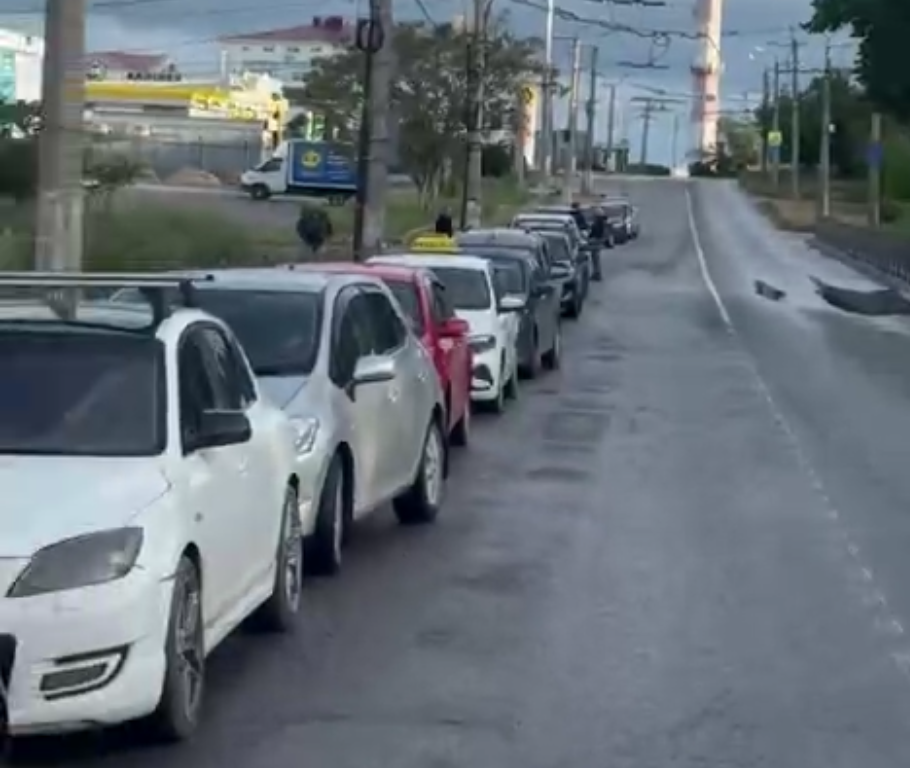
Russia-backed occupation authorities in Crimea introduced fuel rationing after Ukrainian strikes disrupted the land corridor supplying the peninsula, with AI-95 coupons and AI-92 sales capped at 20 liters per customer. The article also cites a 12-hour communications blackout at the Zaporizhzhia nuclear plant, Storm Shadow strikes on Russian infrastructure in occupied Luhansk, and continued property seizures and child removals in occupied areas. The combined developments point to escalating war disruption across energy, logistics, and occupied-territory governance.
The market implication is not the battlefield headlines themselves, but the compounding logistics failure. Once fuel starts getting rationed in a rear-area hub, the constraint migrates forward into convoy velocity, generator usage, maintenance cycles, and the ability to sustain air-defense coverage; that tends to create a lagged but self-reinforcing degradation in operational tempo over the next 2-6 weeks. The most important second-order effect is that every successful interdiction of the southern corridor forces Russia to re-route through longer, more vulnerable paths, raising transport costs and creating periodic localized shortages even if headline fuel supply later normalizes.
The nuclear-site communications blackout is a separate tail-risk amplifier: it raises the probability of a miscalculation premium rather than a direct disruption premium. For markets, that matters because it increases the odds of sudden, policy-driven escalation or inspection-related interruptions, which can widen risk premia in European power, regional utilities, and adjacent shipping/insurance names if the situation persists for days rather than hours. The real catalyst to watch is not another strike, but whether monitoring agencies start describing the site as functionally unable to maintain redundant communications for multiple cycles; that would be the inflection from an isolated incident to a chronic safety defect.
The property-seizure regime is a slow-burn expropriation trade, not a one-off human-rights event. Over months, it hardens the legal barrier to return, depresses any eventual recovery value of occupied residential assets, and makes postwar title remediation far more expensive; that is bearish for any reconstruction thesis that assumes clean-chain-of-title normalization. The contrarian point is that the immediate economic pain may still be underappreciated: logistics bottlenecks and fuel rationing are faster-moving than sanctions, so the near-term impact is operationally harsher than the market usually prices in for occupied-territory headlines.
AI-powered research, real-time alerts, and portfolio analytics for institutional investors.
Request TrialOverall Sentiment
strongly negative
Sentiment Score
-0.75
