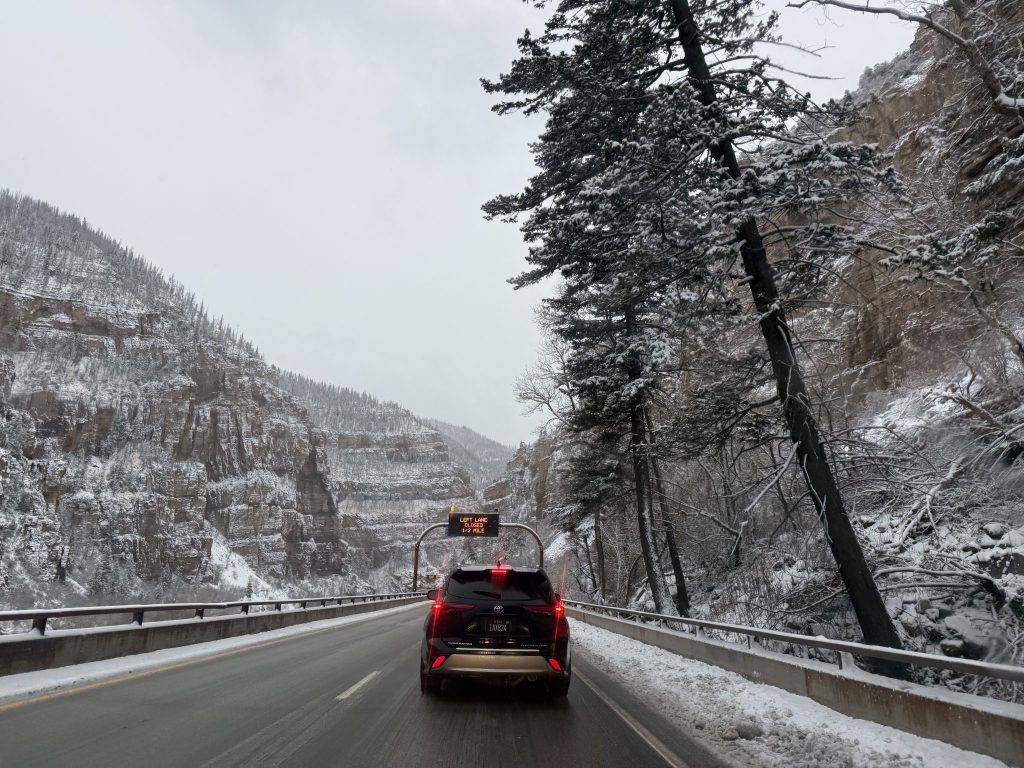
A potent late-season storm is expected to bring up to 20 inches of snow to parts of Colorado's mountains, with peak impacts on Tuesday night and Wednesday morning. Travel on the I-70 mountain corridor could range from slushy to snow-covered, with visibility concerns and likely activation of chain and traction laws through May 31. The main effect is localized disruption to road travel rather than a broader market-moving event.
The immediate market impact is not the storm itself but the operational friction it creates in a high-leverage logistics spine. When mountain pass conditions degrade, the first-order hit is to time-sensitive freight, but the second-order effect is a temporary widening of service gaps: expedited parcel networks, LTL carriers, and regional grocers often absorb higher re-routing and detention costs with limited ability to reprice in real time. The key distinction is between a one-day weather event and a two-to-three-day cascade, where missed linehaul connections can ripple into inventory resets across the Mountain West and parts of the Midwest.
The most exposed names are carriers and shippers with dense exposure to the I-70 corridor and low pricing flexibility, while beneficiaries are more likely to be indirect: tow/recovery services, weather-hedged utilities, and equipment providers tied to winter maintenance. If closures intensify, the market usually underestimates the cost of reliability failures versus pure volume loss; for parcel and truckload operators, the margin hit comes from lower asset utilization and higher overtime, not just fewer loads. The real risk window is Tuesday night through Wednesday morning, but the equity read-through can persist 1-2 weeks if customers shift loads away from vulnerable routes.
The contrarian view is that this is likely too transient to justify broad de-risking across transportation. For large national rail and parcel franchises, the event may be a net margin neutral over a quarter because rerouting and fuel surcharge mechanics partly offset disruption, especially if there is no sustained closure beyond 48 hours. That said, weather events can expose which operators have weak network redundancy, so this is more useful as a relative-value signal than a macro short. The move is probably underpriced for local freight bottlenecks but overextended if extrapolated into a broader transportation downturn.
AI-powered research, real-time alerts, and portfolio analytics for institutional investors.
Request DemoOverall Sentiment
mildly negative
Sentiment Score
-0.15
