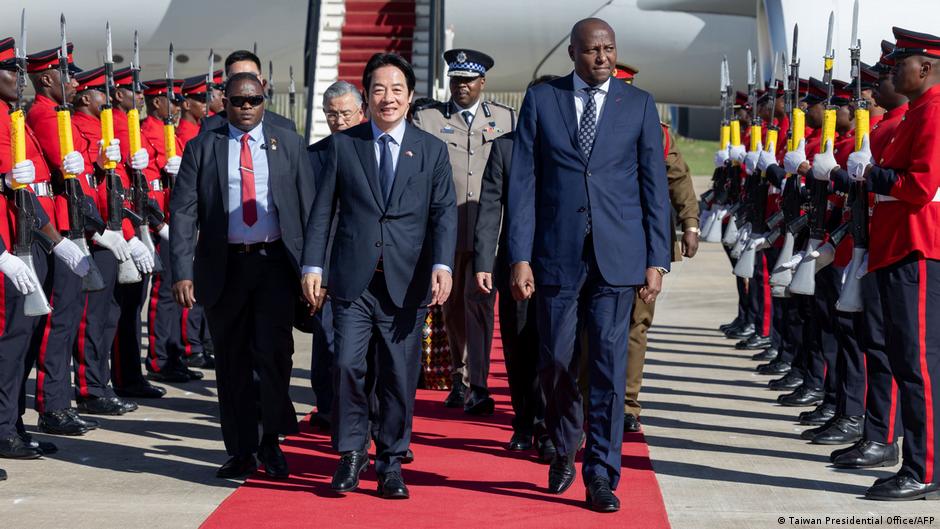
Taiwan President Lai Ching-te visited Eswatini, Taiwan’s only diplomatic ally in Africa, after the trip was delayed when Seychelles, Mauritius and Madagascar withdrew overflight permission amid accusations of Chinese pressure. Beijing condemned the visit as a provocation and reiterated that Taiwan is part of China, underscoring ongoing geopolitical tensions. The article is primarily diplomatic and unlikely to move markets directly, though it highlights continued China-Taiwan friction.
This is not a tradeable Taiwan-specific event by itself; it is a signaling test of how far Beijing is willing to push coercion short of kinetic escalation. The second-order effect is on diplomatic-route risk premia in the Pacific and East Africa: even low-cost transit pressure can now be used to isolate Taipei, which raises the hurdle rate for any future Taiwan outbound diplomacy and slightly increases the probability of miscalculation around elections, security visits, or defense cooperation announcements.
The market implication is not in Taiwan-linked equities directly, but in names exposed to China-sensitive geopolitical volatility: Asian carriers, regional insurers, and semiconductor supply-chain operators could see short-lived volatility if this feeds into broader cross-strait rhetoric. The bigger medium-term winner is defense and dual-use infrastructure spending in countries that sit on the diplomatic fault line; even small states will start pricing redundancy in airlift, satellite comms, port logistics, and cyber resilience over the next 6-18 months.
Consensus likely understates how much these episodes harden alignment politics rather than move sovereign recognition counts. Beijing’s public overreaction is useful for Taipei domestically and for third countries that prefer strategic ambiguity: it makes China look like the costlier counterpart. The contrarian view is that repeated coercion without immediate payoff can become ineffective over time, meaning the real risk is not escalation from this one trip, but policy fatigue — until a more material incident forces a reset.
Catalyst-wise, watch for copycat pressure on future transit permissions and any response from the U.S., Japan, or EU on freedom-of-movement norms. If the rhetoric extends into sanctions, visa restrictions, or military signaling, risk assets in Greater China could re-rate lower over days; absent that, the move is mostly a sentiment event that fades within 1-2 weeks.
AI-powered research, real-time alerts, and portfolio analytics for institutional investors.
Request DemoOverall Sentiment
neutral
Sentiment Score
-0.10
