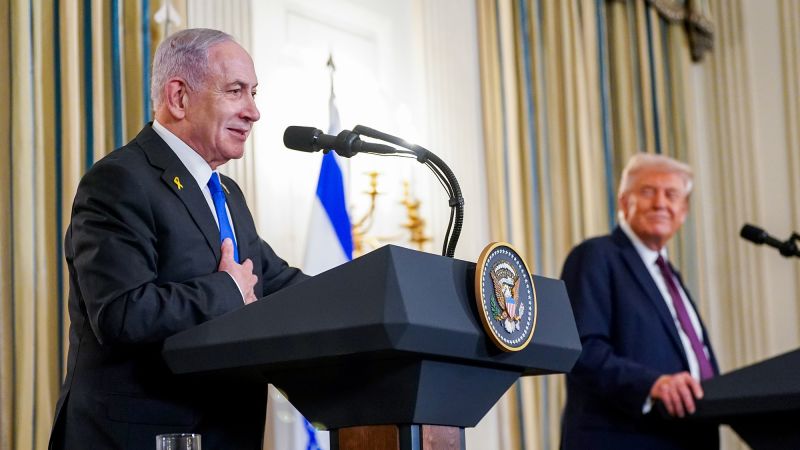
Israeli Prime Minister Benjamin Netanyahu is defending the Trump administration's Gaza peace plan to his hardline cabinet, emphasizing close US coordination and asserting Israel's control over Hamas's disarmament and the ambiguous terms for Palestinian statehood, despite significant internal dissent from key coalition partners. Concurrently, Hamas is carefully reviewing the proposal amid a worsening humanitarian crisis in Gaza and an Israeli ultimatum for northern residents to evacuate. President Trump has set a short deadline for Hamas's response, claiming broad regional support for the plan, which faces immediate challenges from both Palestinian factions and within Israel's government.
The proposed 20-point Gaza peace plan, while publicly endorsed by Prime Minister Benjamin Netanyahu, faces significant internal political headwinds that threaten its viability. Netanyahu is attempting to manage dissent within his hardline cabinet by framing the plan's terms for Palestinian statehood as "ambiguous" and asserting that Israel, alongside the US, would retain ultimate control over implementation, including the disarmament of Hamas "peacefully or by force." However, this narrative is directly contradicted by key coalition partners, such as National Security Minister Itamar Ben Gvir and Finance Minister Bezalel Smotrich, who have labeled the agreement a "resounding diplomatic failure" that compromises Israel's security objectives. This deep division within the Israeli government introduces substantial execution risk. Concurrently, the operational environment is deteriorating, as evidenced by the ICRC's suspension of operations in Gaza City and an Israeli military ultimatum for civilians to evacuate the north. This points to a potential near-term military escalation that could render diplomatic efforts moot, a risk compounded by the short three-to-four-day deadline for a response from Hamas. The situation is defined by high uncertainty and negative sentiment, reflecting the chasm between diplomatic overtures and the realities of internal political opposition and on-the-ground military posturing.
AI-powered research, real-time alerts, and portfolio analytics for institutional investors.
Overall Sentiment
moderately negative
Sentiment Score
-0.50
