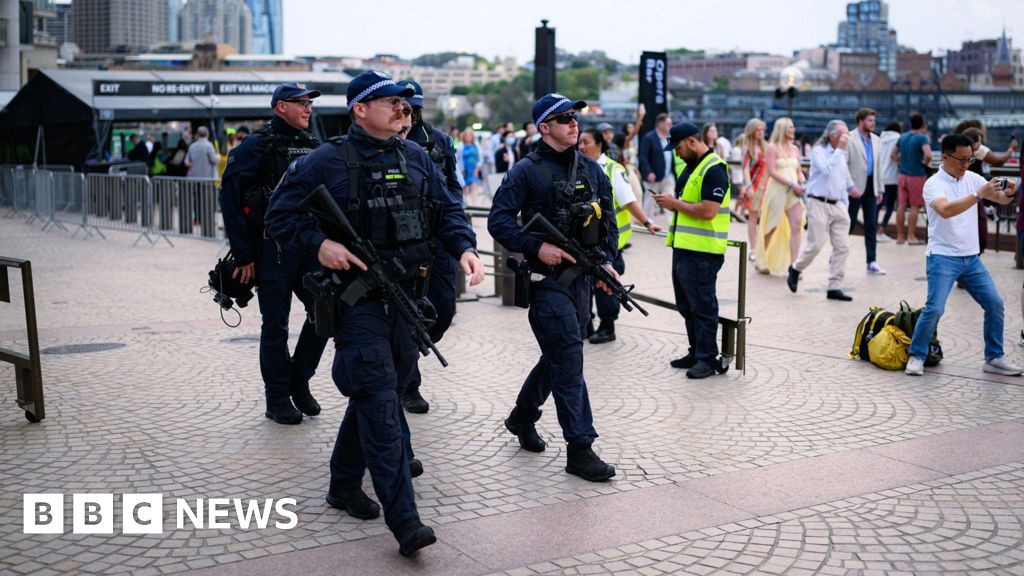
After the 14 December Bondi Beach mass shooting that killed 15 people, New South Wales deployed more than 2,500 officers — with some authorised to carry high‑grade longarms — to secure Sydney's New Year’s Eve, pausing official events for a minute's silence and lighting the Harbour Bridge white. The visible, heavy security presence reassured some tourists but elevates short‑term downside risk to Sydney’s event-driven tourism and consumer revenues (hundreds of thousands still gathered), warranting monitoring of travel bookings, hospitality receipts, insurance exposure and potential public security cost implications.
Market structure: Immediate winners are private/security contractors, defense primes and insurers (pricing power for short-term security services and higher premiums), while travel & leisure (airlines QAN.AX, travel agencies FLT.AX, WEB.AX, hotels CWN.AX, EVT.AX) and adjacent retail/entertainment face demand loss. Expect a 5–20% transient revenue shock for exposed tourism operators over 1–3 months versus a 0–5% hit to large diversified caps; security services can raise rates 5–10% in the short run given constrained capacity.
Risk assessment: Tail risks include a repeat attack or travel advisories that prolong a tourism slump >6 months (high-impact, low-probability) and regulatory reallocation of federal funds away from long-term tourism subsidies into policing. Time horizons: immediate (days) — cancellations and volatility spikes; short-term (weeks–months) — revenue misses for Q4 bookings and higher opex for venue security; long-term (6–12 months) — likely mean reversion in tourist flow unless multiple incidents occur.
Trade implications: Favored tactical trades: short travel/hospitality equities or buy puts for 1–3 months, long Australian 10y government bond exposure and buy AUD puts to express AUD weakness. Relative value: long global defence primes (RTX, BA.L) vs short Australian tourism names for 6–12 months as fiscal/security spending reallocates.
Contrarian: Consensus may overprice a permanent hit — historical analogues (Paris 2015, Nice) show tourist flows largely recover within 6–12 months; use options to size risk — avoid outright large-cap tourism shorts beyond tactical 1–3% book size, and be ready to flip to long on >15% price dislocation.
AI-powered research, real-time alerts, and portfolio analytics for institutional investors.
Request DemoOverall Sentiment
moderately negative
Sentiment Score
-0.30
