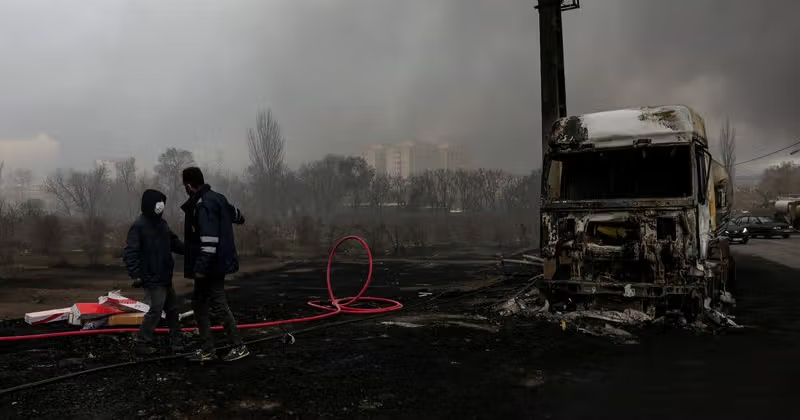
Reported Israeli drone attacks on Tehran checkpoints killed at least 10 people (per state-linked Fars) amid an escalatory US–Israeli campaign that also killed Supreme Leader Ali Khamenei and prompted wartime succession to Mojtaba Khamenei. Energy markets have reacted sharply: Brent briefly surged >25% to $115 then eased to ~$98 (~30% above prewar levels); disruptions to the Strait of Hormuz (previously ~20 million barrels/day and ~330 million cubic meters/day of LNG) plus Iraqi and Kuwaiti ~70% oil output cuts and halted Qatari LNG have strained supplies. The G7 is considering a 300–400 million barrel strategic release, but prolonged closure risks shifting the shock from price volatility to physical shortages, implying sustained risk-off positioning and material supply-chain and inflation upside risks.
The market is moving from price-volatility to physical-shortage risk; that raises the premium on assets with rapid incremental supply response and storage/transport optionality. US onshore producers (Permian-focused) can ramp volumes and capture nearly all incremental margin within weeks, while export-dependent refiners and fertilizer producers reliant on Hormuz-linked sulfur/choke-point logistics face outsized delivery risk and margin compression. Shipping and storage capacity have become a critical choke point — a handful of VLCC/Suezmax re-routings and tank storage fills can amplify downstream shortages within 4–8 weeks even if producers can technically lift output.
Tail risks are asymmetric and time-dependent: in days we get headline-driven price spikes; by 4–12 weeks physical shortages and inventory draws drive the next regime where SPR releases have limited durability. A durable reopening of Hormuz or a coordinated 300–400m barrel strategic release can plausibly shave 20–35% off peak Brent within 2–6 weeks; conversely, targeted strikes on export terminals or sustained interdiction extend the crisis into a multi-quarter supply shortfall. Political/diplomatic catalysts (coalition naval escorts, negotiated corridors) are the highest-probability reversal events but require 2–8 weeks to implement and may only partially restore flows.
From a positioning perspective prioritize convexity (short-dated options and stocks with quick free-cash-flow upside) and avoid capital-intensive, slow-to-adjust names. Shipping and storage equities offer front-loaded upside but rapid mean reversion risk; US E&P exposure is the cleanest way to monetize elevated speculative oil/Gulf premium. Conversely, airlines and refiners with constrained access to alternative crude sources are first-order shorts—fuel is a pass-through cost that will compress margins sharply if disruption persists beyond a month.
Consensus is pricing a persistent, multi-year Gulf shock; that may be overstated. Physical logistics—not crude in the ground—will determine market pain points, which means this episode is more about assets that own or control mobility (tankers, storage, export capacity) than those with longest-duration reserves. If diplomatic channels produce partial corridor reopening within 4–8 weeks, expect rapid roll-down in freight and spot oil gains, so keep time horizons tight and profit-taking rules disciplined.
AI-powered research, real-time alerts, and portfolio analytics for institutional investors.
Request DemoOverall Sentiment
strongly negative
Sentiment Score
-0.85
