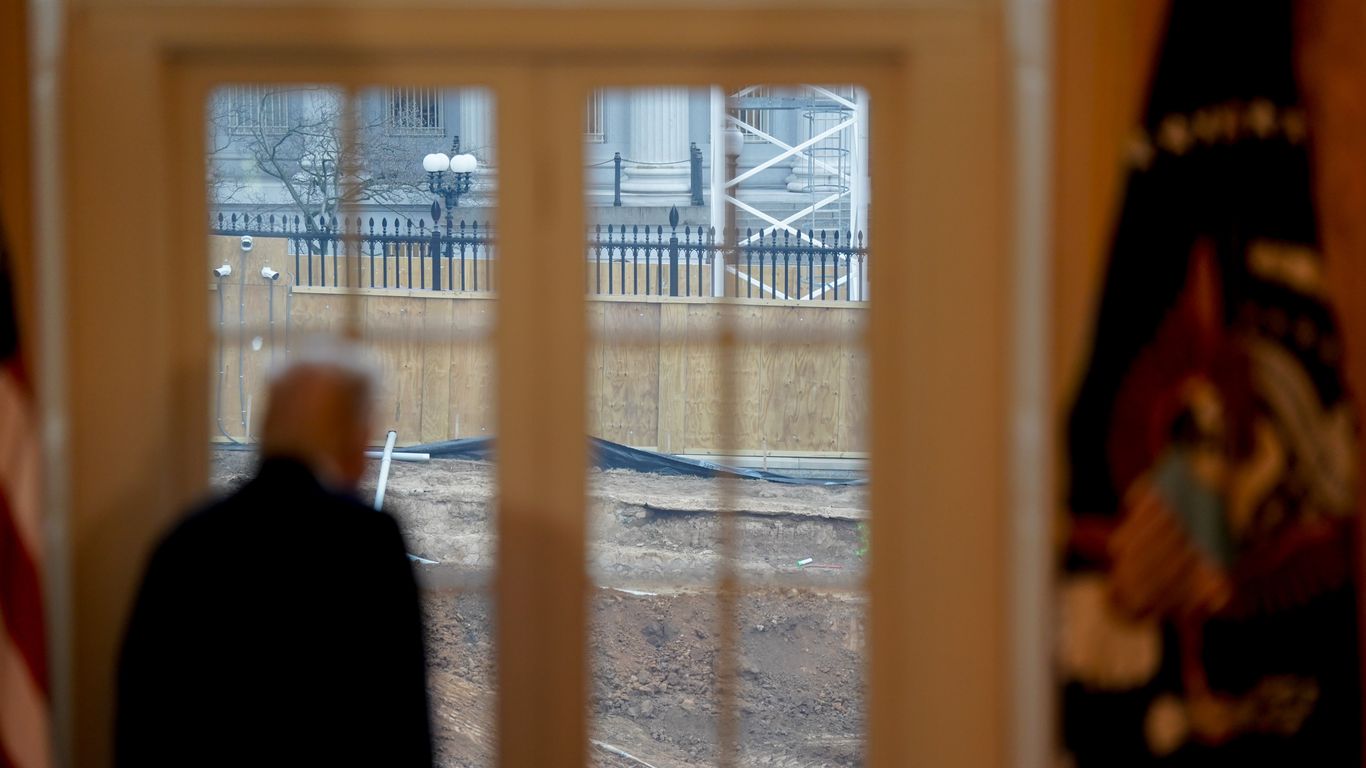
The Trump administration is seeking to resume construction of a $400 million White House ballroom project after a federal judge temporarily halted work, while an appeals hearing is set for June 5. Congressional Republicans are discussing legislation and funding options, including private donations and possible taxpayer money, but there is no clear path yet. The story is primarily a political and legal dispute with limited direct market impact.
The market implication here is not the ballroom itself; it is the precedent risk around executive latitude in federally controlled real estate and permitting. If the administration wins even a narrow procedural victory, it lowers the hurdle for faster, less reviewed capital deployment across adjacent Washington-facing contractors, while simultaneously increasing headline risk for firms exposed to federal procurement, historic-preservation disputes, and politically sensitive public works. The near-term beneficiary set is mostly legal and advisory spend; the losers are entities tied to civic institutions and preservation groups that now face a more hostile regulatory and political environment.
The bigger second-order effect is budget signaling. Once a project is recast as a security necessity, the probability of cost discipline falls, and that tends to pull future taxpayer-funded capex into a higher-overhead, lower-transparency regime. That is bearish for public-sector efficiency but constructive for large contractors with compliance capability, especially if private donations prove insufficient and Congress gets forced into a compromise funding structure. The timeline matters: the legal process is a days-to-months catalyst, while any actual spending or procurement benefit is a months-to-years story.
The contrarian read is that the market may be overestimating how much this materially changes anything in the defense/infrastructure complex. A boutique political project does not automatically convert into broad-based federal spending, and the likely outcome could be delay rather than approval, which would leave contractors with noise but no revenue. The more actionable takeaway is that the event increases volatility around firms dependent on discretionary federal approvals, where a single adverse court ruling could reverse sentiment quickly.
For the administration, the real risk is not legal embarrassment but escalation: if Congress is forced to legislate around a personalized project, it deepens the perception of governance by exception, which can raise the discount rate on all politically exposed assets. That argues for watching for spillover into federal buildings, convention/venue operators, and any REIT or construction name with a meaningful Washington D.C. footprint. The trade is less about direct revenue and more about who benefits if procurement rules get loosened or who gets hit if the court slams the door.
AI-powered research, real-time alerts, and portfolio analytics for institutional investors.
Request DemoOverall Sentiment
neutral
Sentiment Score
-0.05
