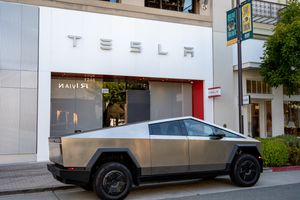
Texas DMV filings show Tesla has just 42 autonomous vehicles authorized for ridehailing in the state, versus 577 for Waymo and smaller fleets of 317 at Avride, 47 at Nuro, and 35 at Zoox. The disclosures come under a new Texas autonomous-vehicle law requiring fleet counts and Level 4 self-certification, raising questions about Tesla's filings given its past Level 2 driver-assistance positioning. The data also highlights Tesla's robotaxi fleet trailing Elon Musk's prior targets by a wide margin, despite the service expanding beyond Austin.
The key takeaway is not simply that Tesla is smaller than Waymo in Texas, but that Tesla is now being forced into a measurable regulatory regime that will surface operational gaps faster than the market expected. That shifts the debate from “can Tesla announce autonomy?” to “can it scale a service business under scrutiny,” which is a materially harder bar because utilization, incident rates, and fleet density become visible monthly. For TSLA, the near-term risk is multiple compression if investors start treating robotaxi as a slow-build option rather than a near-term earnings bridge.
Second-order, Waymo’s larger registered fleet and broader Texas footprint should reinforce its lead in route learning, dispatch efficiency, and insurer/regulator confidence, widening the gap in service quality even if Tesla continues to expand. That matters because autonomy is a data-network business: more vehicles in more cities compounds map coverage, edge-case handling, and rider trust, which can create a non-linear advantage over the next 6-12 months. Tesla’s smaller fleet also implies lower near-term contribution to ride-hailing supply, so any narrative around rapid city-by-city monetization looks premature.
The main catalyst risk for TSLA is that any additional incident, permit delay, or mismatch between claimed autonomy level and regulatory certification could force a reset in rollout expectations within weeks, not quarters. Conversely, the bullish reversal case would require a visibly faster fleet ramp and cleaner safety data over the next 2-3 filing cycles; absent that, the market is likely to fade headline-driven enthusiasm. For GOOGL, this is a quiet reinforcement of Waymo’s strategic moat, though the stock may already discount some of that lead.
The contrarian angle is that the market may be underestimating how little capital is required for Tesla to preserve the option value of autonomy even with a tiny fleet. A small, tightly controlled deployment can still support future software monetization if Tesla keeps incident rates manageable and expands gradually, so outright bearishness on TSLA may be too linear. The real issue is timing: the option is alive, but the probability-weighted payoff has likely pushed out by 12-24 months.
AI-powered research, real-time alerts, and portfolio analytics for institutional investors.
Request DemoOverall Sentiment
mildly negative
Sentiment Score
-0.25
Ticker Sentiment
