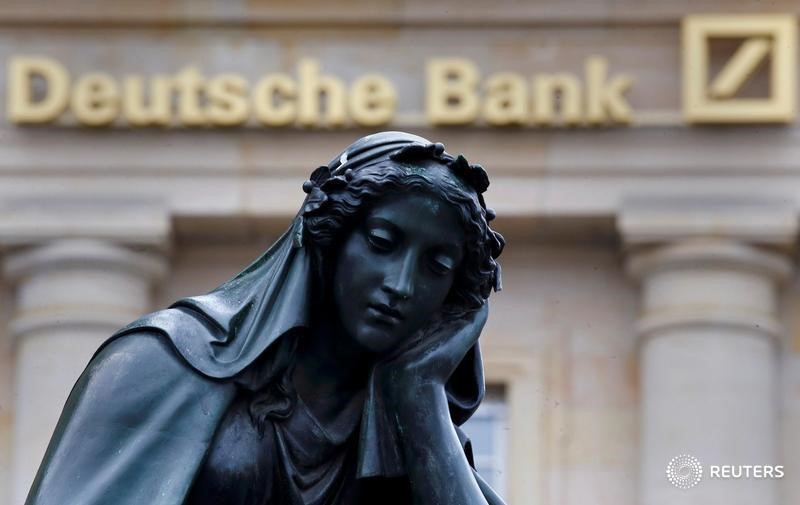
Deutsche Bank reported a record first-quarter profit, with net income up 8% year-on-year to 2.2 billion euros and profit before tax up 7% to 3.0 billion euros. Revenue rose 2% to 8.7 billion euros, post-tax return on tangible equity improved to 12.7%, and the cost-to-income ratio fell to 58.9%. The bank reiterated its 2026 revenue target of around 33 billion euros and continues a 1 billion euro share buyback.
DB is signaling that European universal banks can still compound through the cycle even without a dramatic macro tailwind: the mix of fee resilience, expense discipline, and buybacks is doing the heavy lifting. The market usually underestimates how much incremental capital return matters when the earnings base is stable; with CET1 still comfortably above operating targets, the equity story is less about absolute growth and more about sustained shrinkage of the share count and multiple support from cleaner capital distribution.
The second-order implication is that this print is better for large diversified banks than for smaller lenders. If capital markets activity and wealth flows are holding up, the earnings dispersion inside European financials should widen toward franchises with stronger fee mix, lower funding sensitivity, and better capital return capacity. That argues for relative outperformance in the most liquid, well-capitalized names while subordinated-credit and higher-beta domestic lenders remain more vulnerable to any slowdown in loan demand or credit normalization.
The key risk is that this is a late-cycle quality print: the same metrics that look durable today can roll quickly if deposit competition reaccelerates or provisioning steps up over the next 2-3 quarters. Consensus may also be too complacent on the durability of buyback support; if regulators lean more conservative or macro overlays prove insufficient, the market will re-rate banks on tangible book rather than earnings momentum. The setup is constructive, but the catalyst window is months, not days — this is a slow-burn rerating story unless broader European credit conditions deteriorate.
The contrarian angle is that the market may already be paying for perfection on headline profitability while still underappreciating the downside convexity in a mild credit turn. That makes the better expression a relative-value long in high-quality capital-return banks versus a short in weaker regional or lower-fee peers, rather than an outright sector chase. If the cycle extends, the leaders keep compounding; if it turns, the laggards should compress faster.
AI-powered research, real-time alerts, and portfolio analytics for institutional investors.
Request DemoOverall Sentiment
moderately positive
Sentiment Score
0.55
Ticker Sentiment
