
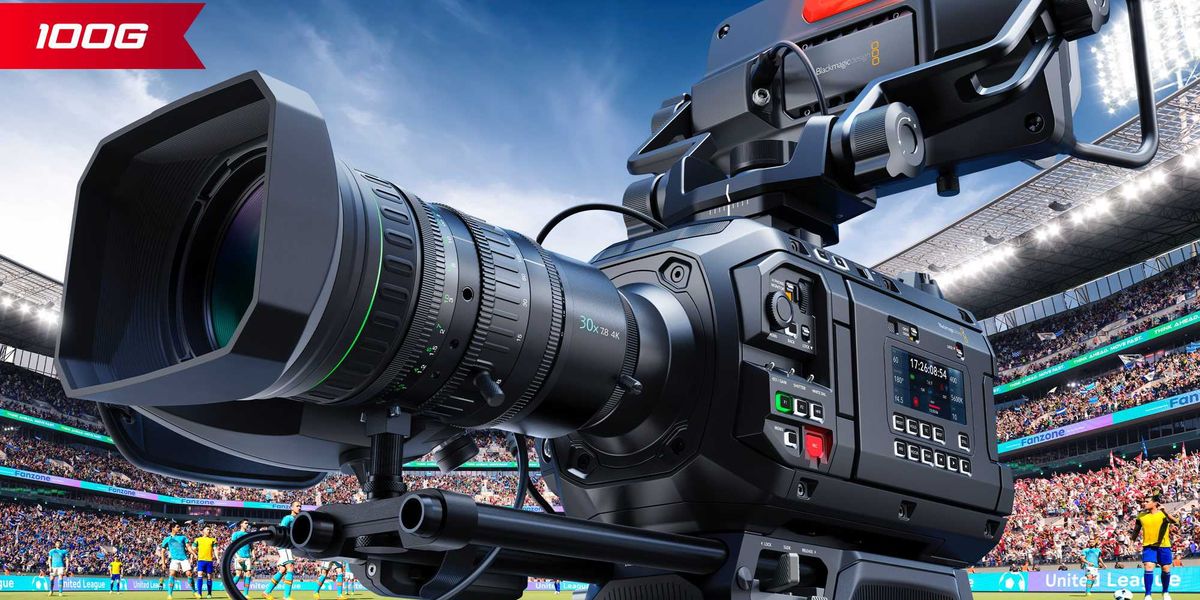
Blackmagic Design unveiled the URSA Cine 12K LF 100G, a new live-production camera with 100G Ethernet, SMPTE-2110 output up to 440 fps, and support for 12K recording at up to 80 fps. The camera is positioned to bring cinematic image quality, 16 stops of dynamic range, and broadcast features such as live streaming and B4/PL/EF/LPL lens support to live production workflows. It will ship in Q3 for US$8,995, excluding duties.
This is less a camera story than a signal that the broadcast stack is being pulled toward IP-native, software-defined workflows. If Blackmagic can normalize cinematic capture in live production, the incremental winner is not just the camera vendor but the adjacent ecosystem: 100G switching, storage, replay, and live orchestration layers that can ingest much heavier data paths. The practical bottleneck shifts from image quality to network architecture, which should favor vendors and integrators that already sell into data-center-grade media pipelines.
The second-order effect is competitive pressure on traditional broadcast incumbents whose value proposition has relied on “good enough” image quality plus entrenched workflows. A sub-$10k price point with premium specs compresses the budget ladder and can force slower-moving OEMs to defend via software, service, or bundled systems rather than hardware margin. That said, adoption will likely be staged: early pull comes from high-end sports, virtual production, and specialty events, while mainstream broadcasters wait for proof that 100G live chains are operationally simpler, not just better on paper.
For NFLX, the relevance is indirect but real: the more live production shifts toward cinematic standards, the more live sports rights become differentiated content rather than commodity feeds. That supports premiumization of sports storytelling over a 12-24 month horizon, but it does not move near-term subscriber math. The bigger contrarian point is that this innovation may accelerate capex intensity across the production ecosystem faster than broadcasters can monetize it, creating a short-term mismatch where quality improves before ROI does.
A key risk is execution friction: 100G live production requires more than camera adoption, including switch infrastructure, training, and workflow redesign. If deployments prove expensive or fragile, this becomes a niche tool rather than a category reset. The catalyst to watch is real-world sports replay and live event demos over the next 1-2 quarters; if major production houses standardize on the format, the adoption curve could steepen quickly.
AI-powered research, real-time alerts, and portfolio analytics for institutional investors.
Request TrialOverall Sentiment
mildly positive
Sentiment Score
0.45
Ticker Sentiment
