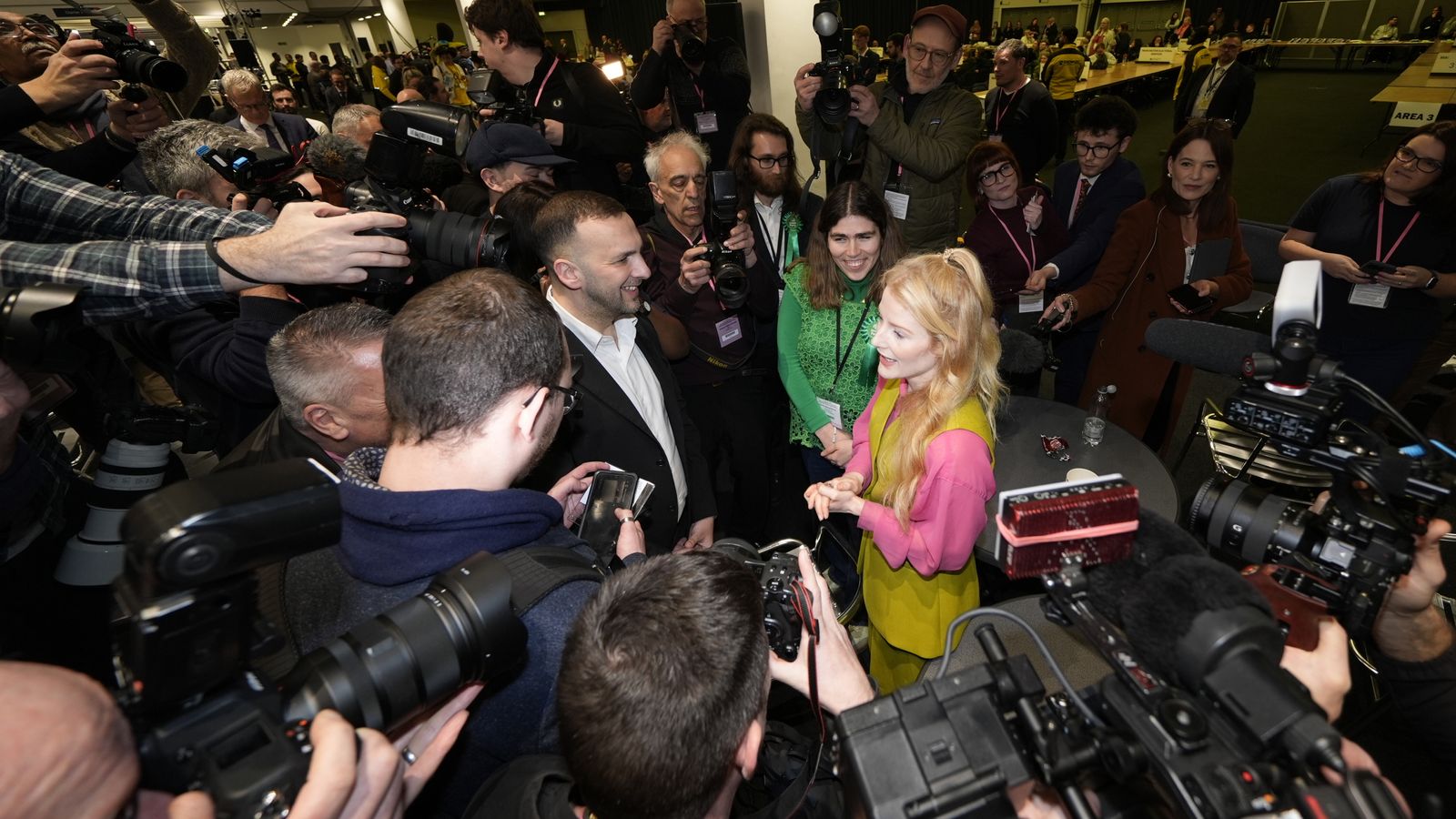
In the Gorton and Denton by-election the Green Party under Zack Polanski won its first parliamentary by-election gain after 87 attempts: Hannah Spencer took 40.7% of the vote (a +27.5pp increase on the last general election) with a Labour-to-Green swing of 26.4%. Labour fell from first to third, losing a prior 36.7% majority as its vote share dropped 25.3pp; Reform UK’s Matt Goodwin finished second with 28.7% (+14.7pp) while the Conservatives polled 1.9%. Turnout was 47.5%, and the absence of a Workers Party candidate was cited as helping the Greens; the result signals a shift toward multi-party competition and heightened political uncertainty for the governing Labour party.
Market structure: The by-election is a signal, not a seismic market event — but it materially increases the probability of sustained multi-party fragmentation in the UK (one-off by-election swing Labour->Green: +26.4pp). Immediate winners on policy signaling are clean-energy developers, grid operators and domestic green industrial supply chains; losers are incumbent Labour-exposed domestic services and fossil-fuel incumbents vulnerable to accelerated regulation. Expect rotation from domestic cyclical mid-caps (FTSE 250) into ESG/renewable names over 3–18 months.
Risk assessment: Tail risks include a snap general election within 6–12 months (we raise subjective odds from ~30% to ~45%), a government policy U-turn, or a contagion of populist gains boosting fiscal loosening that lifts UK yields by >50bp. Short-term (days–weeks) risk is GBP volatility and higher gilt yields; medium-term (1–6 months) is earnings downgrades for UK domestic retailers/services; long-term (6–24 months) is structural policy change favoring renewables/capex for grid and batteries.
Trade implications: Cross-asset: expect 10–75bp upward pressure on 2–10y gilts in volatile episodes and GBPUSD downside pressure of 1–3% on renewed political risk. Relevant trades: long global clean-energy exposure, tactical short FTSE 250/UK domestic cyclical exposure, and buy protection on gilts/GBP; options vol in UK equity indices should rise on any confirmed polling trend. Monitor polls and one-week gilt moves >20bp as triggers.
Contrarian view: The market may overstate by-election extrapolation — Greens’ concentrated local surge may not scale nationally; mean reversion is plausible if Labour retakes messaging in 2–3 months. That argues for staggered entries (scale in on 5–10% pullbacks) and using event-driven triggers (national polls, two more by-election results) before committing >3–5% portfolio weight to UK-political-dependent themes.
AI-powered research, real-time alerts, and portfolio analytics for institutional investors.
Request DemoOverall Sentiment
moderately negative
Sentiment Score
-0.35
