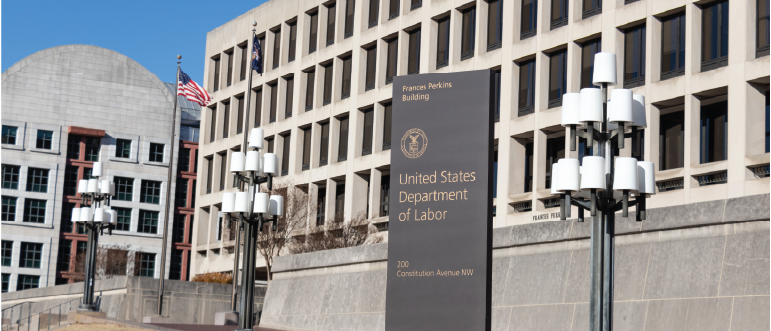
The Department of Labor proposes rescinding the current 29 CFR part 795 analysis and reinstating the 2021 "economic reality" test—with modifications—to determine employee versus independent contractor status under the FLSA, identifying two core factors (nature/degree of control and opportunity for profit/loss) plus additional secondary factors. The proposal, which the DOL says aligns with Supreme Court and circuit precedent and would also apply to FMLA and MSPA, follows a May 2025 suspension of enforcement amid legal challenges and opens a comment period through April 28, 2026; industry group NACS publicly welcomed the return to the economic reality standard.
Market structure: The proposed DOL return to an “economic reality” test raises compliance and labor-cost risks for firms that rely heavily on contractors (ride‑hailing, delivery, franchise maintenance, seasonal retail). Likely winners: HR/payroll vendors (ADP, PAYX), PEOs (TNET) and compliance/legal boutiques that can charge 1–3% of payroll revenues for remediation; losers: gig platforms (UBER, LYFT, DASH) and retail/franchise operators with large contractor pools where margin pressure of 3–8% of revenue is plausible. Credit markets: expect affected issuers’ IG/BB spreads to widen 10–50 bps in stressed scenarios; implied equity vol for names with high contractor exposure could rise 20–40%.
Risk assessment: Tail risk includes a final rule plus adverse circuit-court rulings triggering mass reclassification lawsuits and back-pay liabilities measured in hundreds of millions for large platforms; a conservative stress assumes 2–5% incremental operating cost for exposed firms over 12–36 months. Immediate window: heightened sector volatility around the comment deadline (Apr 28, 2026) and any court orders in the next 3–12 months; long horizon: structural contractual shifts over 1–3 years with state-level divergence (CA, NY). Hidden dependencies: franchise/subcontract chains, insurance/benefit cost pass-throughs, and tax withholding systems will amplify second‑order effects.
Trade implications: Direct longs: ADP (2–3% portfolio tilt) and PAYX (2%), and TNET (1%) to capture compliance spend over 6–18 months. Defensive shorts/protection: buy 3‑month 10% OTM put spreads on UBER and DASH sized 0.5–1% capital (protects against 5–15% equity losses); pair trade long ADP vs short UBER over next 3–12 months. Options: consider buying 60–120 day strangles on top gig names around regulatory news to monetize volatility spikes. Rotate 2–4% from consumer discretionary into software/services over 1–3 quarters.
Contrarian angles: The market may overprice immediate mass reclassification—historical precedent (2020–2024 DOL/state cycles) shows prolonged litigation and rule stays; long-dated disaster hedges (>12 months) may be cheap tail insurance. Conversely, if courts uphold a broad test, short-term selloffs could overshoot by 20–40% in stretch cases—opportunity to buy beleaguered quality franchises with stable cash flows (WMT, COST) at discounts. Monitor three triggers: final federal rule publication, a federal appeals-court injunction, and state AG enforcement announcements—each should guide rebalancing.
AI-powered research, real-time alerts, and portfolio analytics for institutional investors.
Request TrialOverall Sentiment
neutral
Sentiment Score
0.12
