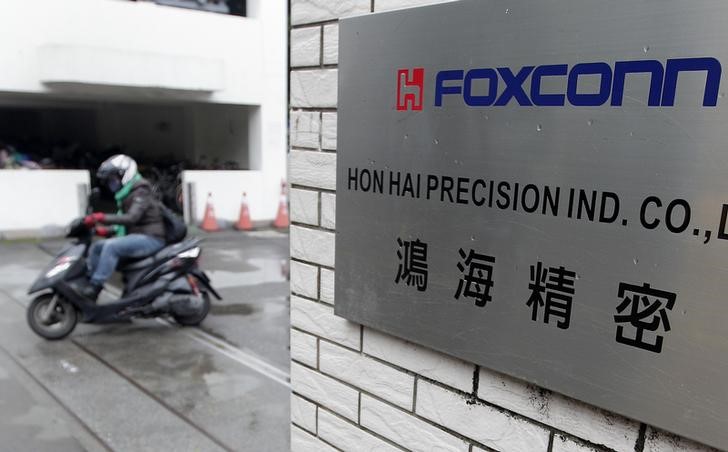
Foxconn reported Q4 net income of T$45.21 billion, down 2.4% year-on-year and well below Bloomberg estimates of T$59.86 billion. Revenue hit a record T$2.603 trillion for the quarter, but weakening margins—especially in consumer electronics and relatively thin server margins—drove the profit shortfall. The company still benefits from strong AI-driven server demand (as a key NVIDIA server supplier) and solid iPhone 17 assembly, though a looming memory-chip shortage tied to AI demand could further pressure sector margins.
Contract-manufacturing margin compression is creating a structural wedge between volume capture and value capture: EMS players will continue to scale revenue with AI/server content while ceding most incremental gross profit to component suppliers (memory, GPUs, custom ASICs) and cloud customers that extract higher unit economics. Over the next 3-12 months expect larger, more capitalized ODMs to win share from smaller EMS players because they can better absorb volatility in component costs and negotiate preferential allocations.
An AI-driven memory tightness is a classic upstream capture — DRAM vendors can reprice into a short-cycle windfall while assemblers with thin server margins cannot. If DRAM ASPs rise 20-30% over the next 3-9 months, memory makers should show outsized EBITDA upside versus EMS firms; conversely, any early destocking at hyperscalers would reverse that move quickly, creating a high gamma environment for memory equities and options.
For NVDA and AAPL the second-order risks diverge: Nvidia benefits from sustained server intensity but faces a supply-chain elasticity constraint where rising memory costs compress system-level gross margins for customers (clouds, OEMs), potentially slowing reorder cadence in a 6-12 week window. Apple has the pricing power and dual-sourcing optionality to shift assembly away from margin-constrained partners, creating asymmetric downside for single-source EMS suppliers while supporting Apple's margin resilience over the next two earnings cycles.
Key catalysts to watch are quarterly guidance from memory vendors and Foxconn, hyperscaler capex signals, and cross-strait trade policy moves. Tail risks include a China consumer slowdown or rapid hyperscaler optimization that reduces memory intensity per server — both would unwind the DRAM price upside within months and crush leveraged calls in memory names; conversely, continued AI spend could make this one of the fastest 3-quarter DRAM rallies on record.
AI-powered research, real-time alerts, and portfolio analytics for institutional investors.
Request DemoOverall Sentiment
mildly negative
Sentiment Score
-0.25
Ticker Sentiment
