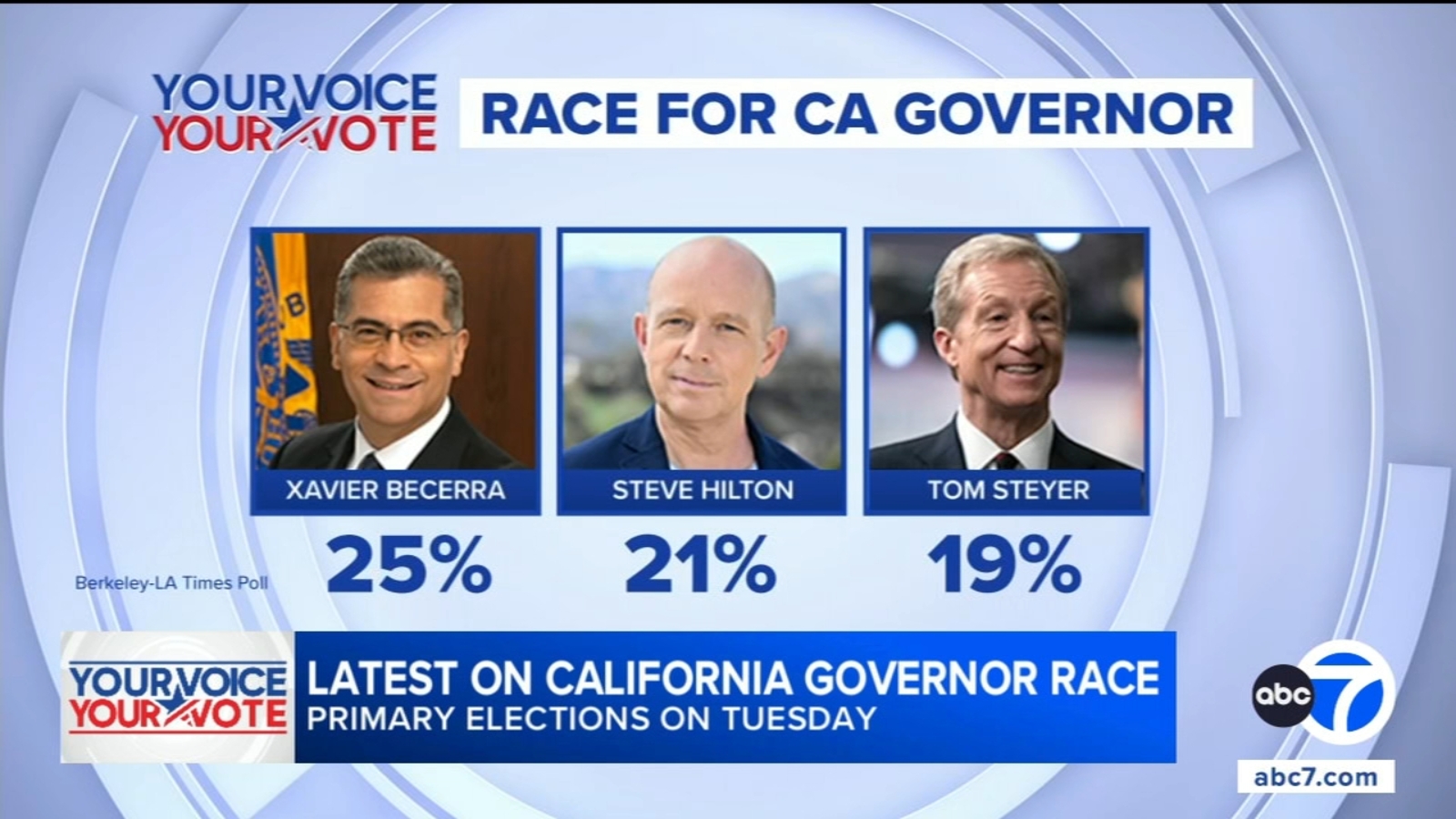
California’s governor race remains tight, with Xavier Becerra leading at 25% in a Berkeley-Los Angeles Times poll, followed by Steve Hilton at 21% and Tom Steyer at 19%. Chad Bianco fell to 11% from 16%, while Katie Porter slipped to 7% from 13%, leaving the runoff field unresolved. The article is politically relevant but has minimal direct market impact.
The market implication is not a clean “red vs blue” trade; it is a volatility trade on runoff construction. The most important second-order effect is that a two-Democrat runoff would likely compress policy dispersion on fiscal, labor, and regulation, reducing the probability of a hard-right policy swing that some sectors may have discounted into California-exposed assets. That setup is marginally supportive for utilities, REITs, and regulated infrastructure names with California exposure because the tail risk is less about ideology than about tax/permit continuity.
The bigger tradable wrinkle is donor- and media-budget efficiency: the candidates currently fighting for the same lane are likely to burn capital trying to redefine each other, which raises the odds of a late-stage consolidation or a tactical advertising surge into the final two weeks. That usually benefits the better-funded, higher-recognition contender and hurts names dependent on low-propensity turnout, so any asset class proxy for “reform/anti-incumbent” sentiment is vulnerable if the field narrows in a way that looks status-quo preserving. From a sentiment perspective, the relevant horizon is days to weeks, not months; runoff math and polling momentum can move quickly and then gap on debate nights or endorsement announcements.
The contrarian view is that the market may be underestimating how much a Republican runoff slot, even if not a win, can re-energize national attention and fundraising flows into California policy fights, especially around housing, energy, and public safety. That could modestly lift headline risk for California-regulated sectors over the next 1-3 months even if the gubernatorial outcome remains probabilistically favored for the leading Democrat. The asymmetry is that the current polling spread may look stable, but small shifts in turnout among independents and soft partisans can flip the second runoff seat, creating a sharp repricing in the final 10-14 days before the primary.
AI-powered research, real-time alerts, and portfolio analytics for institutional investors.
Request TrialOverall Sentiment
neutral
Sentiment Score
-0.05
