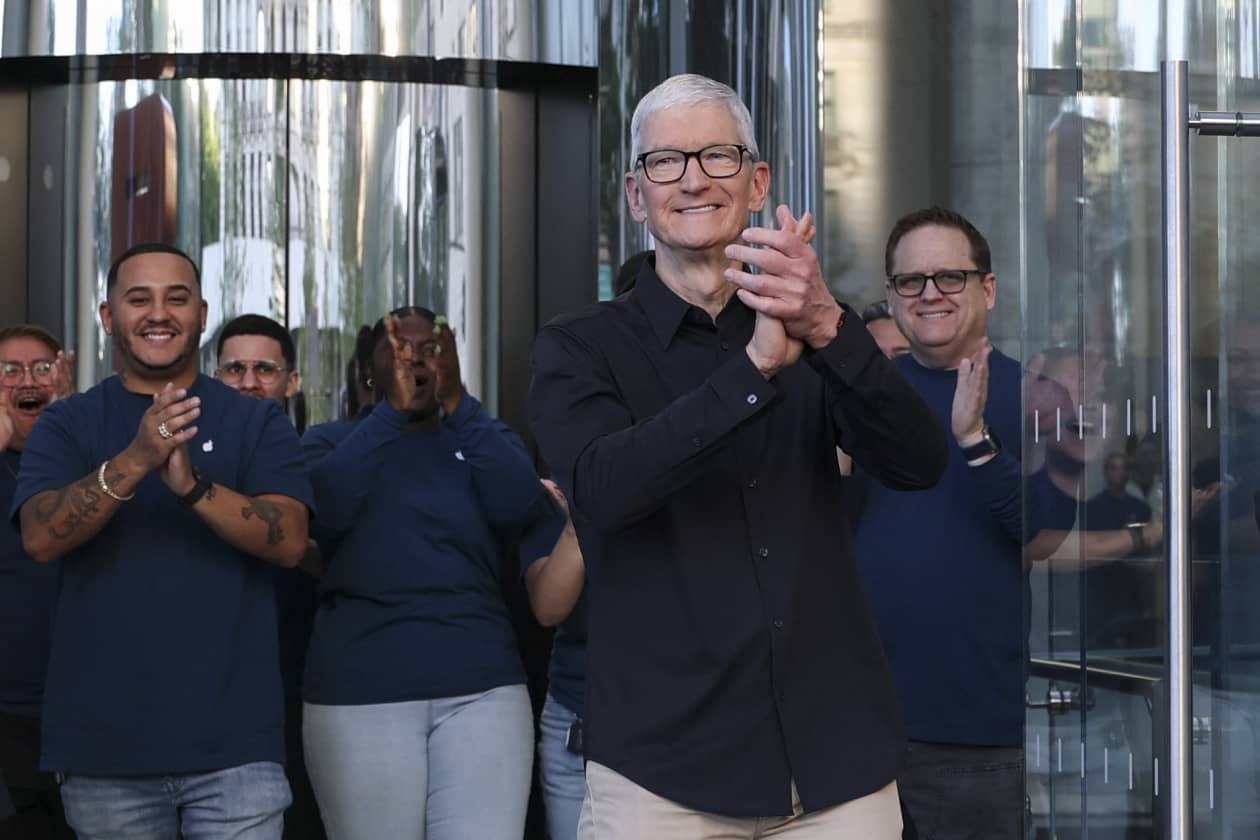
Apple announced a CEO transition: Tim Cook will step down on Sept. 1, 2026 after 15 years as CEO, and John Ternus will take over while Cook remains executive chairman. The article highlights Cook’s tenure, during which Apple reached $1T, $2T and $3T market cap milestones and the stock rose 1,932%, far outperforming the S&P 500’s 504% gain. The news is important for governance and succession planning, but it is largely a planned transition rather than an immediate operational catalyst.
The transition itself is less important than the signal it sends about Apple’s next phase: governance is being used to reduce “single-founder-CEO” dependency while preserving continuity through an insider who knows the product roadmap and hardware organization. That lowers execution risk in the near term, but it also makes strategic change more incremental, which is often a headwind for multiple expansion because the market tends to pay up for surprise optionality, not stewardship. The key question is whether the new regime can re-accelerate product mix, not merely defend margins.
Second-order, this is likely a modest positive for suppliers and ecosystem partners that benefit from stability in procurement and platform direction, but a relative negative for fast-moving AI infrastructure names that need Apple to be a more aggressive capex/customer adopter. If the transition is interpreted as “no radical pivot,” the market may continue to underwrite Apple as a cash-return compounder rather than a product-cycle winner, keeping valuation anchored to earnings growth that remains modest versus mega-cap peers. That creates an interesting setup for dispersion trades: Apple may lag if the broader market re-rates toward AI beneficiaries.
The contrarian view is that governance continuity can be more bullish than a disruptive external hire because it preserves Apple’s historically high operating discipline through a period when many tech firms are over-investing in uncertain AI initiatives. The real catalyst is not the date of succession but the first 2-3 quarters after the handoff, when investors will look for evidence of capital allocation changes, product cadence, and whether the new CEO pushes harder on hardware/software integration. If that signal is absent, the stock likely trades in a range; if there is evidence of a more aggressive platform strategy, the multiple can expand quickly because expectations are still low.
AI-powered research, real-time alerts, and portfolio analytics for institutional investors.
Request DemoOverall Sentiment
neutral
Sentiment Score
0.05
Ticker Sentiment
