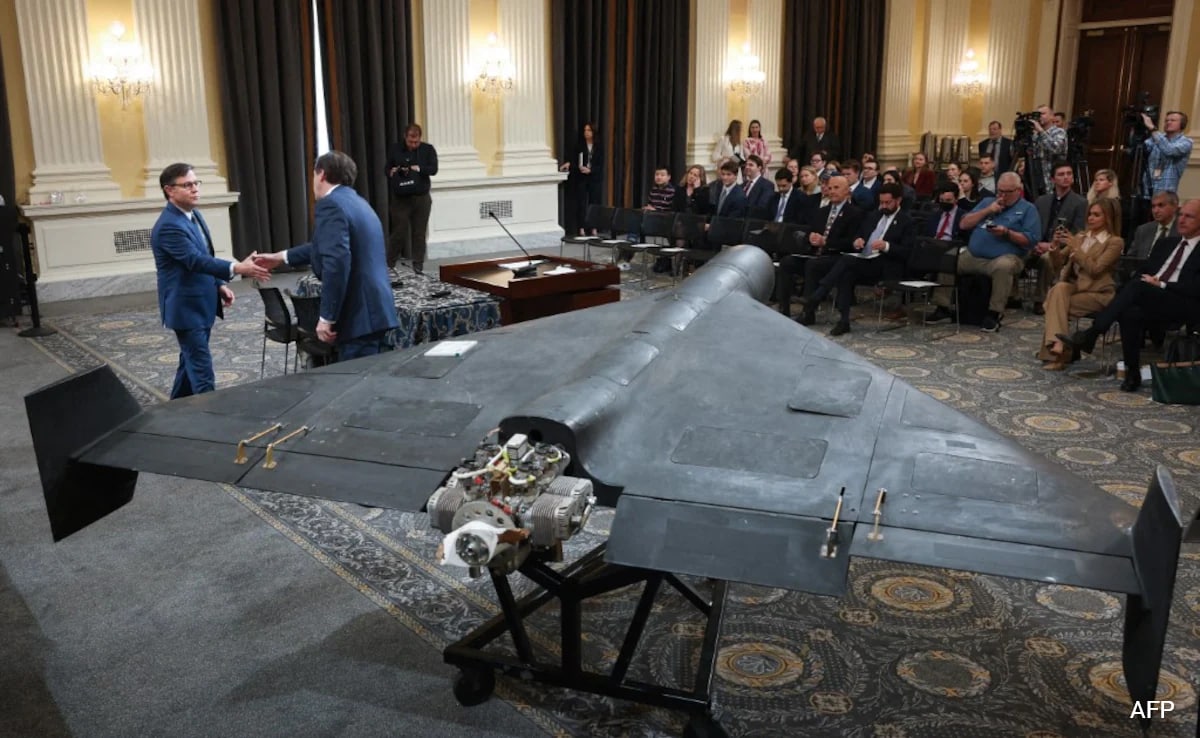
Seven US service members have been killed by Iranian Shahed drones; US officials now say Kyiv offered battle-tested interceptor technology months earlier that the Trump administration dismissed and is now being revisited. Shahed drones cost roughly $20k–$50k each versus interceptor systems that cost millions, creating a significant cost-asymmetry that pressures defense budgets and tactics. Ukraine pitched a production partnership potentially scaling to ~20 million drones/systems and US manufacturing jobs, which would have major supply-chain and industrial implications if pursued.
The market reaction to Iran’s Shahed problem will not be a one-off procurement win for big primes; it is accelerating a doctrinal shift from expensive, centralized interceptors to networked, low-cost, attritable solutions that Ukraine has already industrialized. That shift amplifies demand not just for interceptor airframes but for distributed sensors, command-and-control middleware, and rapid contract manufacturing capacity in Turkey/Gulf/Eastern Europe — areas where smaller, nimble suppliers can win share quickly and where unit economics matter (sub-$100k per interceptor vs. multi-million-dollar missiles).
Second-order winners include mid/small-cap unmanned systems and radar/integration specialists able to field COTS solutions at scale within 3–18 months; losers are large legacy missile programs whose per-shot economics become politically and operationally untenable. Expect procurement to flow via accelerated prototyping and OTA/other flexible vehicles, compressing time-to-contract from 18–36 months to 3–9 months for pilot deployments and to 12–24 months for scaled production.
Short-term catalysts are weekly-to-monthly: contract announcements, Congressional earmarks, and DoD pilot deployments (0–90 days). Medium-term (6–24 months) risk is escalation-driven capex reallocation—large emergency funding can turbocharge incumbents’ backlogs, reversing relative outperformance for niche suppliers. Tail risk: a sudden successful asymmetric countermeasure (software patch, EW) could materially shorten procurement cycles and leave hardware manufacturers with stranded inventory within 12 months.
AI-powered research, real-time alerts, and portfolio analytics for institutional investors.
Overall Sentiment
mildly negative
Sentiment Score
-0.35
Ticker Sentiment
