
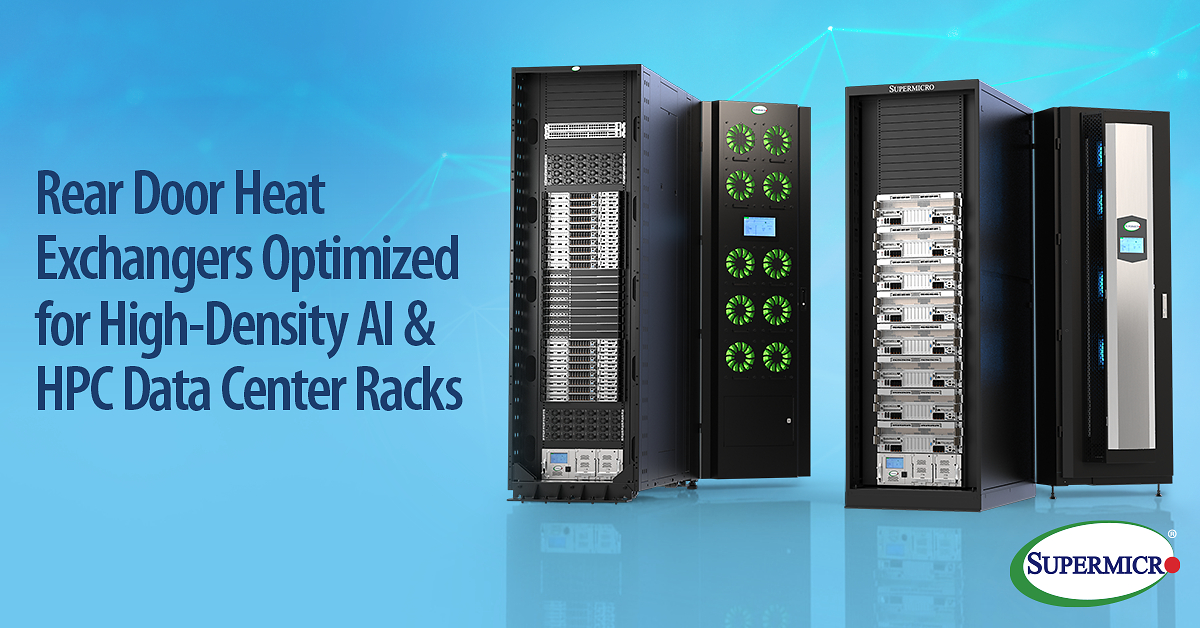
Supermicro expanded its Data Center Building Block Solutions (DCBBS) Rear Door Heat Exchanger (RDHx) portfolio to 10 models covering 10kW to 120kW of cooling capacity at the door level (up to 240kW at rack level). The RDHx systems target rapid, low-disruption liquid cooling for high-density AI/HPC deployments, including compatibility with standard EIA, ORv3, and MGX racks and integration with D2C liquid cooling. The announcement emphasizes reduced integration risk and faster Time-to-Online (TTO) via validated rack-scale delivery with monitoring through Redfish/SNMP/SuperCloud Composer.
The incremental value here is not the product launch itself; it is that AI cooling is moving from a bespoke engineering problem toward a standardized procurement line item. That tends to shift wallet share away from server OEMs that merely bundle hardware and toward platform vendors with install base, service capability, and facility integration depth—meaning Vertiv (VRT) and Eaton (ETN) are structurally better positioned to capture the larger, stickier economics if liquid cooling adoption broadens beyond greenfield builds.
For SMCI, the near-term effect is mostly narrative support rather than immediate revenue leverage. The key question is whether this lowers deployment friction enough to shorten sales cycles and improve conversion on AI racks, or whether it just adds another SKU layer with limited margin expansion; the latter is more likely unless the company can show attach rates, pricing power, and lower return/rework risk. The market should discount the press-release language until next quarter's backlog mix and gross margin show that cooling is becoming a real differentiator rather than a feature checkbox.
Second-order, easier retrofit paths should modestly benefit colocation operators and hybrid-enterprise data centers that were previously capacity-constrained, which could extend the life of older facilities and reduce urgency to migrate workloads to brand-new campuses. That is mildly negative for pure new-build assumptions in the supply chain and could temper some of the most aggressive facility capex projections, while still supporting the broader AI infrastructure trade. The contrarian risk is that if this meaningfully expands the addressable base, the winner may be the cooling/power layer, not the server box maker.
Catalyst-wise, the next 1-3 months matter more than the announcement itself: watch for any evidence of qualified deployments, backlog commentary, or mix shift toward higher-density liquid-cooled systems. If SMCI prints better-than-expected AI revenue but flat-to-down gross margin, the market will likely conclude this is commoditizing rather than expanding returns; if margins inflect and service attach rises, the thesis changes. Longer term, standardized retrofits could compress differentiation across OEMs and make scale players with balance-sheet strength the more durable compounders.
AI-powered research, real-time alerts, and portfolio analytics for institutional investors.
Request TrialOverall Sentiment
mildly positive
Sentiment Score
0.20
Ticker Sentiment
