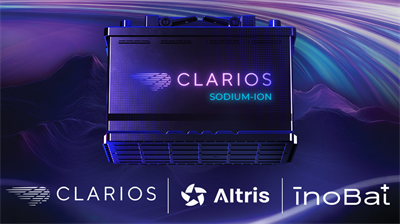
Clarios has deepened its equity investment in Swedish sodium-ion developer Altris, formalized a Joint Development Agreement on the Power Sodium platform, and confirmed plans to start serial production of low-voltage sodium‑ion batteries at a dedicated European or U.S. facility before the end of the decade. The partners are assembling prototype automotive test cells with Slovak manufacturer InoBat (pilot line capacity ~50,000 cells/year) and validating performance (cold-start to −25°C) in Clarios’ Hannover R&D; the move ties into Clarios’ $6 billion U.S. investment plan (including $1 billion for next‑gen technologies) and is intended to localize supply chains, reduce reliance on non-Western raw materials, and accelerate commercialization for OEM customers.
Market structure: Clarios’ push toward serial sodium‑ion for low‑voltage automotive cells primarily benefits Western battery pack integrators, OEMs seeking localized supply (reduced supply‑risk premium) and materials suppliers tied to sodium/iron/hard‑carbon chemistries; legacy lead‑acid and low‑voltage Li‑ion suppliers face demand erosion over a multi‑year window. Expect downward pricing pressure in the 12V/48V segment: if sodium‑ion unit cost achieves >15% discount vs small Li‑ion in 2028–2030, adoption accelerates across fleet models and compresses margins for incumbent makers.
Risk assessment: Near term (days–months) market impact is muted; key risks are execution (scale‑up failures, cell life/cycle issues) and OEM qualification cycles of 2–4 years. Tail risks include a safety recall or regulatory restriction that stalls OEM adoption (high‑impact, low‑probability) and supply chokepoints in specific precursors (hard carbon) that could spike input costs by >20%.
Trade implications: Favor exposure to European/American pack integrators and suppliers that can capture local production (12–36 month horizon) and underweight pure lead‑acid manufacturers; consider directional option strategies to express this view with limited capital. Monitor catalysts: OEM qualification announcements, InoBat/Clarios pilot results, and EU/US manufacturing subsidies—material order flow should surface within 12–24 months.
Contrarian angles: Consensus treats sodium‑ion as niche; downside: OEM integration complexity (battery management systems, cold‑start guarantees) may delay scale so public beneficiaries are likely smaller and later than headlines imply. Upside surprise is possible if Clarios secures OEM supply contracts by 2027 — that would force rapid re‑rating of contract manufacturers and parts suppliers in 2027–2029.
AI-powered research, real-time alerts, and portfolio analytics for institutional investors.
Request DemoOverall Sentiment
moderately positive
Sentiment Score
0.45
