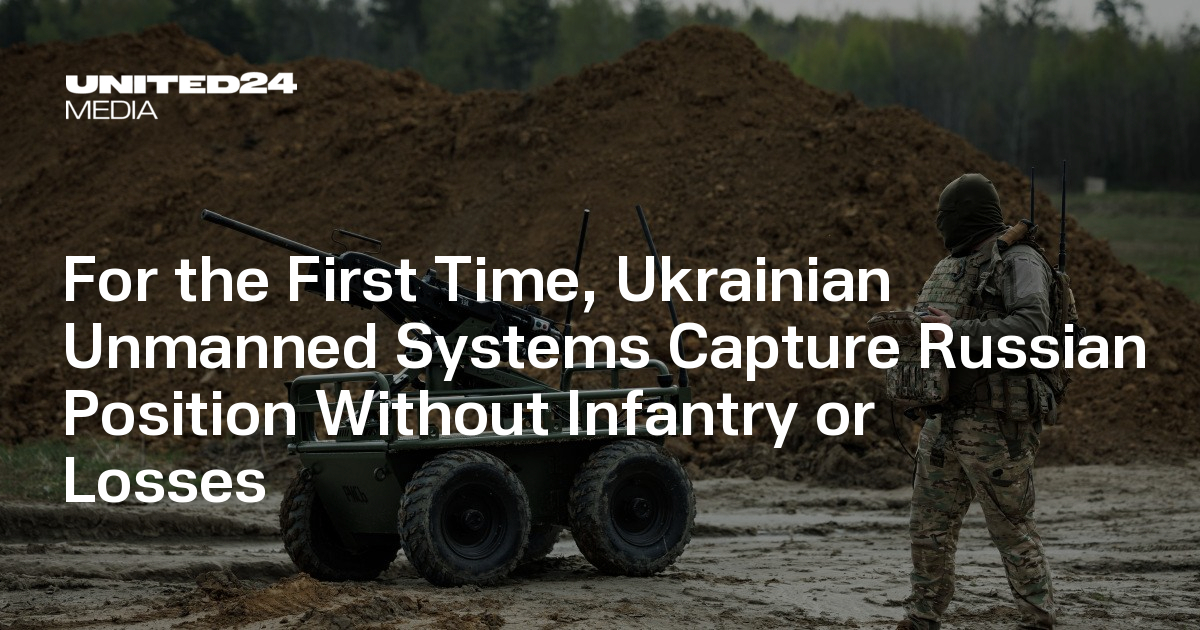
Ukrainian forces took a Russian position using only unmanned platforms—UGVs and drones—with no infantry participation and no losses on their side, marking a notable battlefield milestone. Zelenskyy said robotic systems completed more than 22,000 missions over the last three months, while Syrskyi reported robotic task volume rose 50% in March and ground-robot missions exceeded 9,000 in March 2026. The article highlights rapid scaling of unmanned defense capabilities, with deployed units increasing from 67 in late 2025 to 167 by spring 2026.
This is less a battlefield anecdote than an inflection point for defense procurement economics. Once unmanned systems can force a surrender without infantry exposure, the relevant buyer is no longer just the army but the entire security apparatus, because the KPI shifts from firepower to survivability per mission. That should accelerate budget reallocation toward autonomous ground vehicles, counter-UAS, encrypted comms, edge AI, and battlefield software integration — the “winner” is the systems integrator that can package hardware + autonomy + logistics into a repeatable workflow. The second-order effect is on industrial capacity, not just front-line tactics. Scaling from ad hoc deployments to routine missions implies demand for motors, batteries, thermal cameras, rugged semiconductors, RF links, and spares; the supply chain is likely to bottleneck on low-cost components and field maintainability rather than exquisite platforms. If the operational tempo keeps rising, the marginal value of cheap, disposable robots will rise faster than that of expensive one-off systems, favoring vendors with manufacturing throughput and unit economics over pure defense primes. The market is probably underpricing how quickly this bleeds into Western doctrine. Even if the war itself is a noisy signal, procurement committees will treat this as a live demo that low-cost autonomy can substitute for scarce manpower in contested environments; that is a multi-year tailwind for defense electronics, autonomy software, and dual-use robotics. The contrarian risk is that many of these systems are highly localized and jam-prone, so one successful operation does not mean durable battlefield dominance — any widely publicized EW countermeasure or logistic failure could slow adoption for 1-2 quarters. From an investing perspective, this is bullish for names exposed to autonomous defense, but the trade should be targeted rather than a blanket long defense. The cleanest setup is to own the picks-and-shovels layer where demand can scale without platform wins, while fading pure legacy-manufacturing exposure that benefits less from autonomy adoption. Near term, catalysts are procurement headlines and budget revisions over the next 3-12 months; the key risk is that the narrative outruns actual unit deployment capacity.
AI-powered research, real-time alerts, and portfolio analytics for institutional investors.
Request DemoOverall Sentiment
mildly positive
Sentiment Score
0.25
