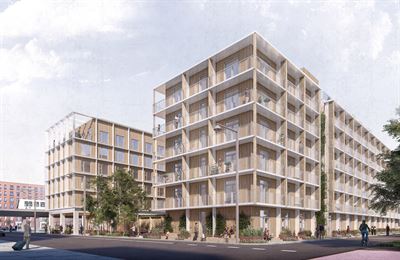
Skanska has sold a mixed-use residential and hotel development at Ørestads Boulevard 31 in Copenhagen to Urban Partners for DKK 608M (≈SEK 890M), a transaction to be recorded by Skanska Commercial Development Nordic in Q4 2025 with property transfer on completion (scheduled summer 2028). The five-floor, 13,100 sqm project comprises 8,400 sqm of residential space (210 units), 4,700 sqm of hotel apartments (143 units) and a 1,350 sqm courtyard, and will be DGNB Gold certified; the deal crystallizes development value while reducing Skanska's forward development exposure and is modest relative to group 2024 revenue of SEK 177 billion.
Market structure: The deal benefits Urban Partners (buyer) and Skanska (developer) by transferring construction/lease-up risk off Skanska’s balance while signalling institutional appetite for flexible, ESG-certified urban housing in Ørestad. Winners also include Nordic residential landlords and construction suppliers (materials, M&E) who gain pricing power if institutional demand scales; local boutique hotel operators may face modest competitive pressure from 143 new serviced units in 2028. The transaction size (DKK 608M / ~SEK 890M) is small vs Skanska group revenue but material to Commercial Development Nordic P&L timing (Q4 2025 recognition) and to local micro-market supply-demand balance.
Risk assessment: Key tail risks are construction cost overruns, delayed DGNB Gold certification, a Danish regulatory shift on flexible/hotel housing, and a 100–200bp adverse move in Nordic rates that re-prices cap rates and yields. Immediate impact (days) is negligible; short-term (months) centers on accounting and financing visibility into Q4 2025; long-term (to summer 2028) is execution and local market absorption. Hidden dependencies include Urban Partners’ financing/leverage, cross-currency (DKK/SEK) translation, and cap-rate sensitivity to Scandinavian rate cycles.
Trade implications: Direct equity plays: modest long positions in Skanska (SKA B) ahead of the Q4 2025 booking and in stable residential landlords (HEIM B) and construction suppliers (NCC B). Use option call spreads on SKA B to capture the Q4 2025 catalyst while capping premium outlay. Rotate 1–3% from high-leverage REITs (SBB B) into developers/owners with lower execution risk; hedges should trigger if Danish 10y mortgage yields rise >75bp.
Contrarian angles: The market may under-appreciate that Skanska is de‑risking and crystallizing value—this recurring sell-down pattern historically compressed developer beta and improved TSR. Conversely, if institutional buying of flexible housing scales, cap-rate compression could surprise on the upside and push tenant markets to re-price rents; regulatory backlash (rent controls) is an asymmetric downside to watch over 12–36 months.
AI-powered research, real-time alerts, and portfolio analytics for institutional investors.
Request DemoOverall Sentiment
mildly positive
Sentiment Score
0.35
