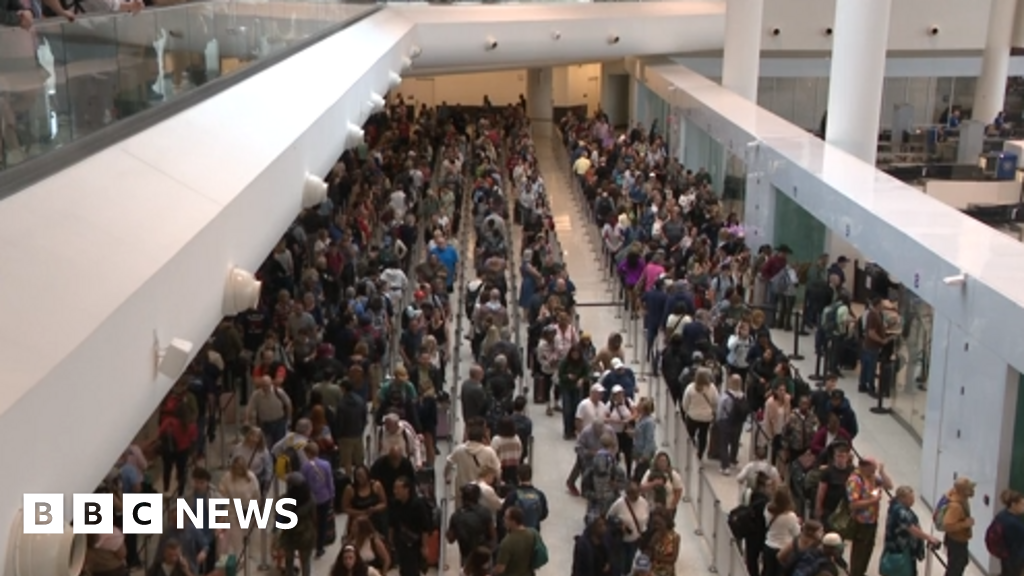
Thousands of travellers faced hours-long security queues at Houston and New Orleans airports, with reported wait times exceeding three hours and airports advising passengers to arrive 3–5 hours early. The delays are linked to a partial DHS funding lapse since Feb 14 that has left TSA officers working without pay and caused staffing shortages. The disruption is driven by a political standoff over immigration reforms, raising the risk of extended operational strain across US airports if the shutdown continues.
When frontier operational reliability degrades, throughput shocks compound nonlinearly across network carriers: a localized 5–10% reduction in screening throughput at major hubs typically forces 2–4% effective capacity cuts for affected carriers over a rolling 30-day window because aircraft and crew cannot be rebalanced intra-day. That creates outsized short-term margin pressure (rebooking, hoteling, passenger compensation) concentrated in carriers with high single-airport exposure and limited spare aircraft.
From a labor-economics vantage, delayed or uncertain cashflows for essential frontline staff raises short-term absence and attrition risk well before formal bargaining changes are enacted; expect spot-market hiring, elevated overtime, and contractor substitution to push unit security costs up by a visible amount in the following 4–12 weeks if uncertainty persists. Those incremental costs are frequently socialized through either fee-waivers, airport reimbursements, or higher ancillary charges — a redistribution mechanism that benefits last-mile and short-notice service providers more than legacy network operators.
Politically-driven funding shocks create a two-stage trade: an immediate operational disruption and a medium-term procurement reallocation. Emergency funding resolutions historically produce a 6–12 month surge in contract awards to established defense/security integrators and technology suppliers, while simultaneously accelerating interest in friction-reducing investments (biometrics, PreCheck substitutes) that shrink the long-run TAM for manual screening.
Market-clearing catalysts that would reverse current pressure are clear: a funding resolution with explicit backpay and rapid temporary hires (days–weeks) or a court/administrative intervention forcing rollbacks. Conversely, an outcome that ties DHS funding to broader legislative concessions would extend uncertainty into a multi-quarter regime, creating persistent dispersion between airport-adjacent service winners and carrier losers.
AI-powered research, real-time alerts, and portfolio analytics for institutional investors.
Request DemoOverall Sentiment
mildly negative
Sentiment Score
-0.30
