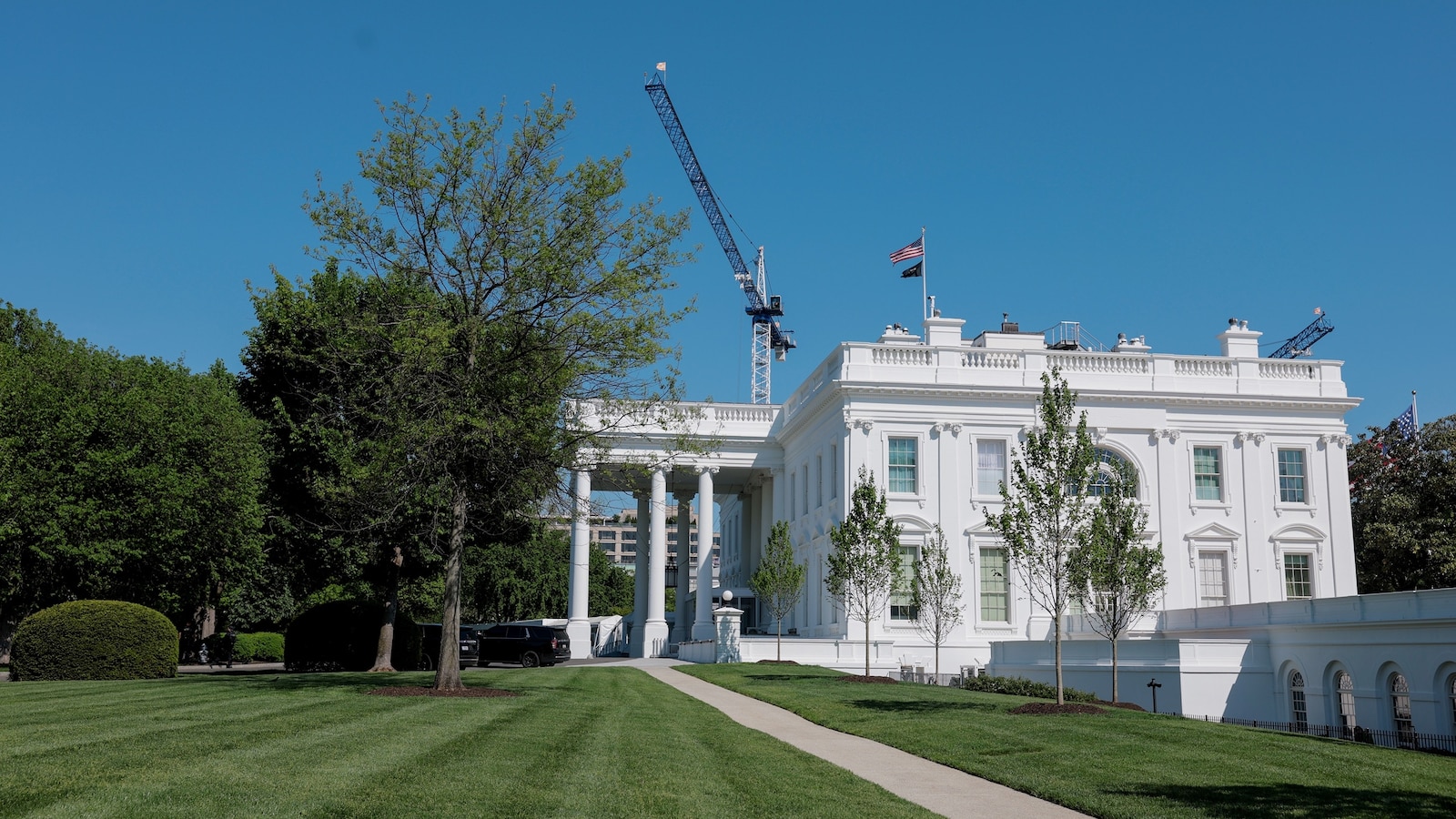
Senate Republicans introduced a bill to provide $400 million in customs-fee funding for President Trump’s proposed White House ballroom, reversing his prior claim that the project would be privately funded. Separately, DOJ filed a motion to lift a judge’s injunction blocking construction without congressional authorization, escalating the legal fight over the 89,000-square-foot expansion. The article is primarily political and procedural, with limited direct market impact.
The market implication is not the ballroom itself; it is the normalization of emergency-framed discretionary spending around a politically symbolic asset. If this line holds, the marginal beneficiary is not a single contractor but the broader federal “security + civic infrastructure” complex: defense engineering, perimeter systems, access control, and high-spec mechanical/electrical builders that can package speed, secrecy, and compliance. The second-order effect is that procurement could shift away from pure architectural spend toward bundled security retrofits, which tends to favor large-cap primes and diversified government services firms over local GCs.
The legal path is the real gatekeeper. A 60-vote financing bill is a low-probability near-term catalyst, but the DOJ’s aggressive posture increases the odds of a negotiated political workaround or partial appropriation buried in a must-pass vehicle over the next 1-2 quarters. If the court fights drag, the project can still become a multi-year headline generator that keeps option value alive for contractors and security suppliers, while also creating a recurring negative news overhang for any firm publicly seen as underwriting the project.
The contrarian angle is that this may be less about new spend than reclassification of already-planned security capex. If so, the net fiscal impulse is smaller than the headline suggests, and the trade should focus on companies that can win share from complexity rather than on anyone reliant on the ballroom being built. Also, because the timeline extends toward 2028, the market may over-discount an immediate earnings uplift that will not show up in estimates for several cycles.
Risk is asymmetric around political reversal: a change in House/Senate control, a court injunction staying in place, or public backlash over cost could freeze the opportunity quickly. That means the best entries are on dips after headline spikes, not on initial enthusiasm. Any long should be paired against a funding-sensitive federal contractor basket to isolate the idiosyncratic security-infrastructure tailwind.
AI-powered research, real-time alerts, and portfolio analytics for institutional investors.
Request DemoOverall Sentiment
neutral
Sentiment Score
-0.05
