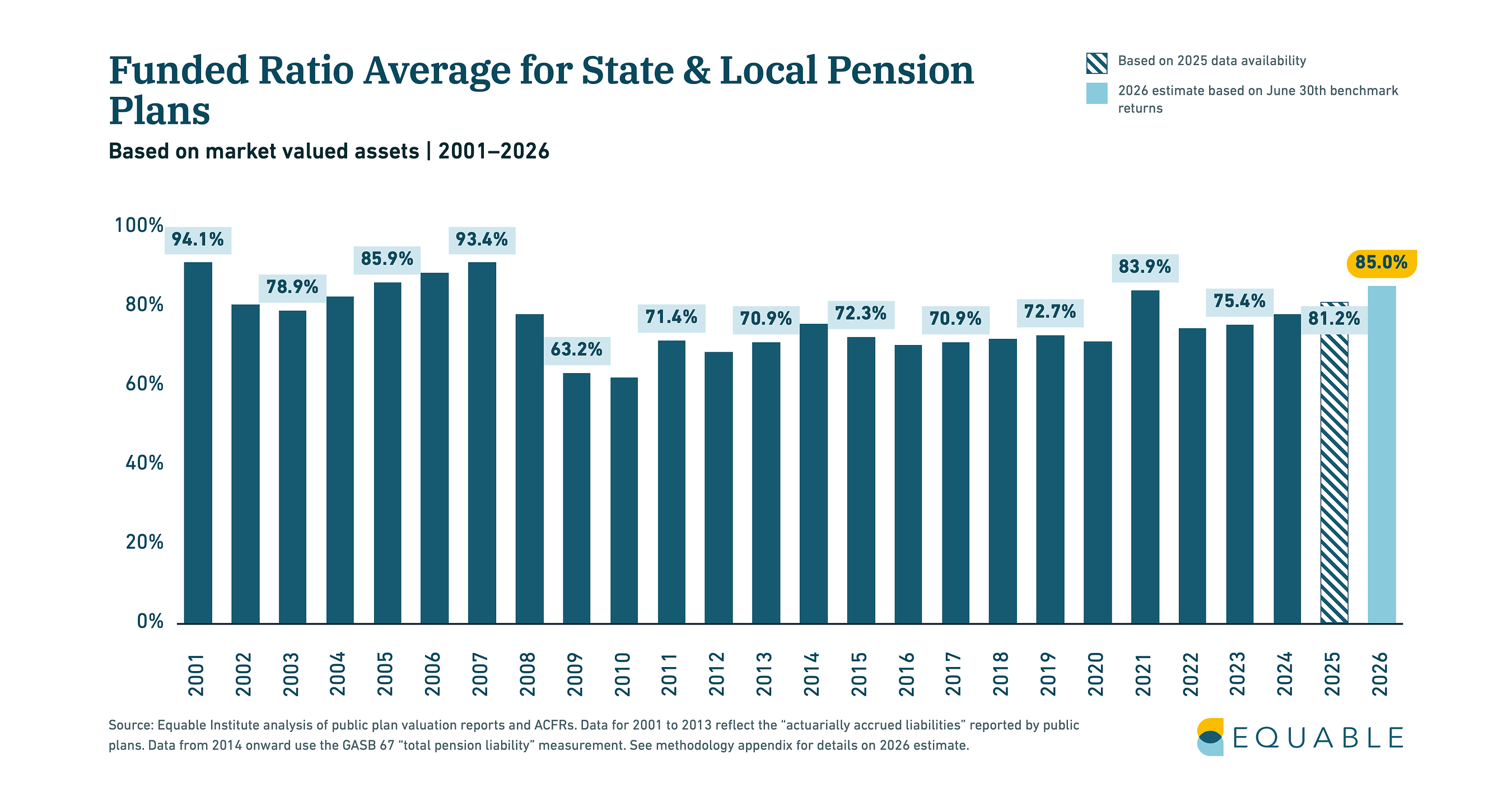
Equable Institute reports U.S. state and local pensions in their strongest funded position since 2009, with the national funded ratio projected to rise to 85.0% in FY2026 (from 81.2% in 2025) and total unfunded liabilities falling to $1.13T (from $1.37T). Plans are projected to earn a 9.4% average investment return versus a 6.9% assumed target for a fourth straight year, but risks are highlighted: over 27% of pension assets have values estimated rather than set by open markets (record high) and 8%–10% (~$513B–$642B) are directly exposed to an AI-related basket. The article frames the near-term recovery as reliant on concentrated, valuation-dependent investments, leaving downside risk if markets weaken.
The near-term signal is constructive for state/municipal credit, but the more important market effect is that pension health is now mechanically tied to a very narrow set of large-cap AI winners. That creates a hidden reflexive bid for cap-weighted indices and mega-cap tech as long as the AI earnings/capex tape stays intact; the same concentration also means a single factor shock can hit funded status, public equities, and sponsor budgets at the same time.
The real risk is not today’s marks but the lag. If AI spending decelerates, or if private asset marks are revised lower, the apparent improvement in funded status can unwind faster than contribution rates can adjust, forcing sponsors back into de-risking and higher cash contributions over 6-18 months. That would be a headwind for small caps, cyclicals, and anything reliant on local-government fiscal flexibility; there is no clean direct read-through for CRMT, MRES, or TGT absent company-specific pension disclosure or demand sensitivity.
Contrarian takeaway: consensus is likely overestimating how durable this de-risking tailwind is. The improvement is mostly a mark-to-market story with high valuation dependence, not a structural fix to cash-flow adequacy. In practice, this looks more like a market-positioning story than a fundamental macro regime change.
AI-powered research, real-time alerts, and portfolio analytics for institutional investors.
Overall Sentiment
mixed
Sentiment Score
0.10
Ticker Sentiment
