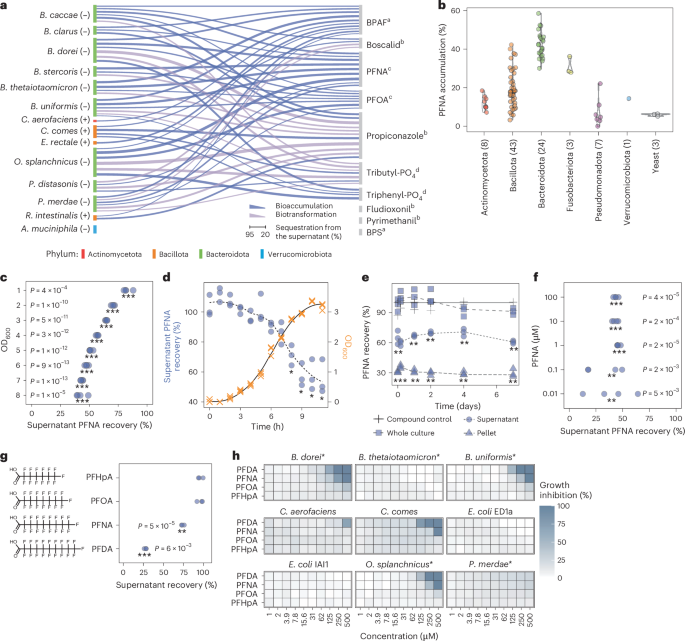
New research reveals human gut bacteria, particularly Gram-negative species like Bacteroides uniformis, possess a significant capacity to bioaccumulate per- and polyfluoroalkyl substances (PFAS) at high intracellular concentrations. This bioaccumulation, confirmed in vitro and in vivo through increased fecal excretion in colonized mice, suggests gut microbiota play a critical role in PFAS toxicokinetics. The findings have substantial implications for understanding human exposure, informing future regulatory measures, and potentially developing novel bioremediation or detoxification methods for these persistent environmental pollutants.
A foundational study in Nature Microbiology reveals that human gut bacteria can bioaccumulate Per- and polyfluoroalkyl substances (PFAS) to a significant degree, altering the understanding of how these 'forever chemicals' interact with biological systems. Key findings indicate that certain bacteria, particularly Gram-negative species such as Bacteroides uniformis, can sequester PFAS, resulting in intracellular concentrations over 50 times higher than the surrounding environment. This process is rapid, occurring within minutes, and is effective even at the low nanomolar concentrations found in contaminated water. The mechanism is not passive; experiments using E. coli mutants demonstrated that the absence of the TolC efflux pump increased bioaccumulation five-fold, indicating active transport. Crucially, in vivo experiments validated these findings: mice colonized with human gut bacteria showed significantly higher fecal excretion of PFNA (a type of PFAS) compared to germ-free mice, directly linking the microbiome to a key PFAS excretion pathway. This research establishes the gut microbiota as a critical mediator in PFAS toxicokinetics, potentially influencing human exposure levels, health impacts, and the efficacy of detoxification.
AI-powered research, real-time alerts, and portfolio analytics for institutional investors.
Overall Sentiment
Neutral
Sentiment Score
0.00
Ticker Sentiment
