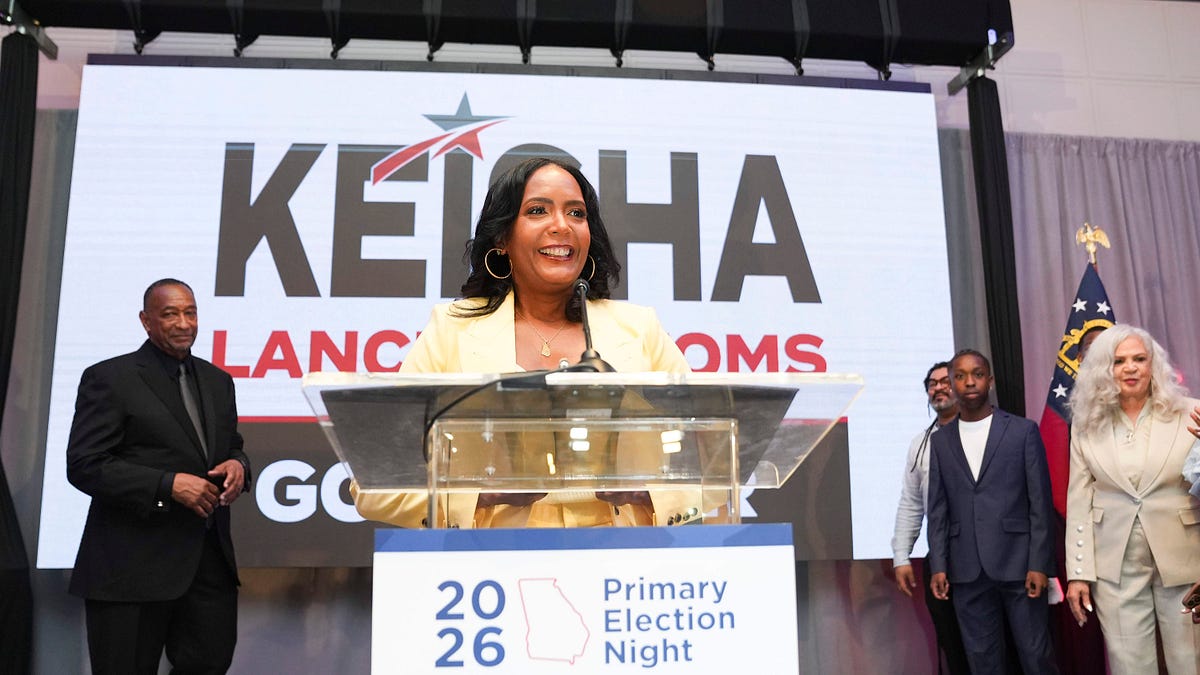
Keisha Lance Bottoms won Georgia’s Democratic gubernatorial primary with 56% of the vote, avoiding a runoff and leaving party officials concerned about her general-election viability. The article highlights broader implications for the 2028 presidential landscape, since Democratic senators Jon Ossoff and Raphael Warnock could rely on the next governor to appoint replacements if either leaves the Senate. Republican Lt. Gov. Burt Jones remains a key wildcard after posting 38% in the GOP primary runoff, underscoring the state’s high-stakes political setup.
The market takeaway is not the nominee herself; it’s the probability that Georgia remains a high-volatility political asset with downstream consequences for state policy continuity, judicial composition, and the 2028 presidential map. A Democratic governorship materially improves the odds of stable redistricting, a more predictable legal environment, and a lower tail-risk appointment process if a Senate vacancy opens — all of which matter disproportionately to national Democrats because Georgia is now a structural swing state rather than a one-off battleground.
The second-order effect is that the Republican nomination outcome raises the odds of governance shocks: an election-denying or highly partisan executive would increase litigation risk, amplify disputes around election administration, and keep Georgia in the headlines for the wrong reasons during a presidential cycle. That tends to benefit campaign consultants, media, and data/field vendors in the near term, but it is negative for state economic optics and for any companies exposed to public-sector procurement or incentive stability.
The contrarian read is that the “weak general election nominee” narrative may be overstated if the real driver is black female turnout and low-information primary dynamics, which can be replicated in a general with sufficient national money and a GOP candidate that remains polarizing. The more material issue is time horizon: the near-term trade is about volunteer, ad, and ballot-security spending over the next 6-12 months; the longer-dated issue is whether Georgia remains governable enough to anchor Democratic presidential ambitions in 2028. The risk/reward is asymmetric because a small shift in turnout or candidate quality can flip a statewide result that then cascades into Senate succession, redistricting, and the broader national bench.
AI-powered research, real-time alerts, and portfolio analytics for institutional investors.
Request DemoOverall Sentiment
neutral
Sentiment Score
-0.10
