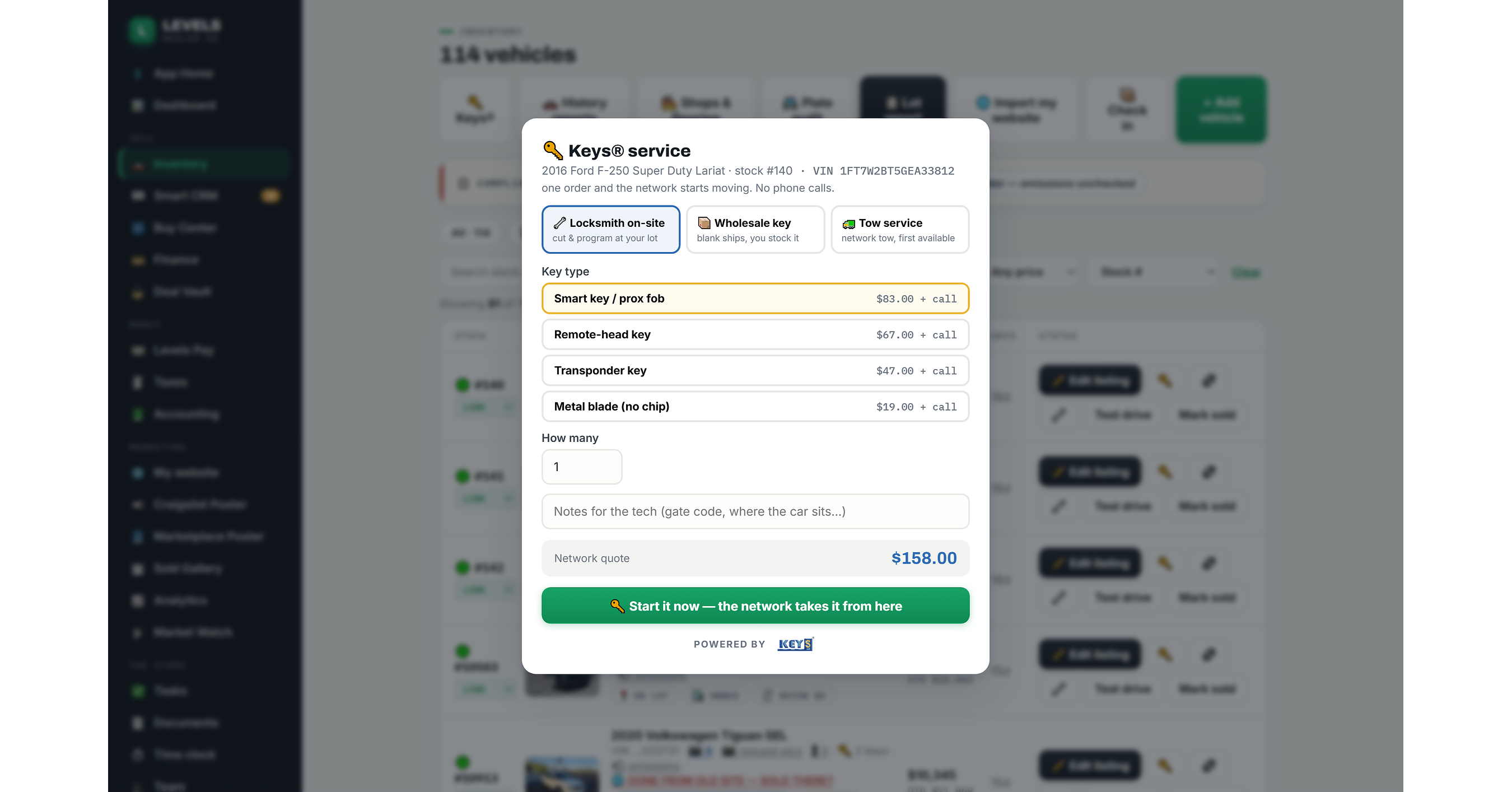
Keys Inc. announced an exclusive partnership with Levels Inc. to integrate Keys AI into Levels Dealer OS, enabling dealerships to match vehicles to the correct OEM/aftermarket key and connect directly to a qualified locksmith. The Levels Dealer OS integration is expected ahead of the September 1, 2026 launch and aims to cut “guessing” by using in-dealership vehicle data (e.g., VIN/year/make/model) to drive key selection and provider fulfillment. The article is product/partnership-focused with no financial guidance, implying modest near-term stock impact.
This is more a workflow-partnership signal than a near-term economic event, so the public-market read-through is limited. The real mechanism is dealership throughput: if key replacement, programming, and fulfillment become embedded in dealer software, the winners are the platforms that sit inside the service/reconditioning workflow, while standalone local locksmith routing and manual parts procurement get disintermediated over time. The first-order financial impact is probably too small to move any single public name, but a successful rollout would modestly improve used-car turn, reduce recon slippage, and protect dealer gross by cutting avoidable delays.
The second-order benefit is to dealer groups with high used-vehicle mix and tighter inventory discipline, especially AN, LAD, GPI, and ABG, where shaving even a few hours off recon can matter at the margin. The negative side is more diffuse: OEM key programs, aftermarket distributors, and fragmented locksmith dispatch businesses face incremental pricing pressure if the software standardizes matching and routing. Still, this is a sell-side story only if adoption scales beyond a niche; otherwise the market will treat it as another point solution layered onto an already crowded dealership software stack.
The biggest risk is overestimating TAM and moat. Key identification is data-intensive and edge-case heavy, so a polished demo does not prove durable workflow capture; if the system misidentifies edge VIN/trim/frequency cases, dealers will revert to phone calls fast. Watch for proof points in the next 1-3 months: named dealer logos, transaction volume, attach rate, and whether levels becomes embedded in service/recon rather than a one-off app launch. A sustained rollout across 6-18 months could matter, but only if it measurably reduces days-to-frontline and labor leakage.
Contrarian take: the market may miss that this is less about AI and more about controlling a small but painful operational bottleneck. That makes the near-term monetization modest, but it also means the upside is in stickiness, not headline ARR. If management cannot show hard utilization metrics by the first post-launch quarter, the story likely fades back into category noise.
AI-powered research, real-time alerts, and portfolio analytics for institutional investors.
Request DemoOverall Sentiment
mildly positive
Sentiment Score
0.20
