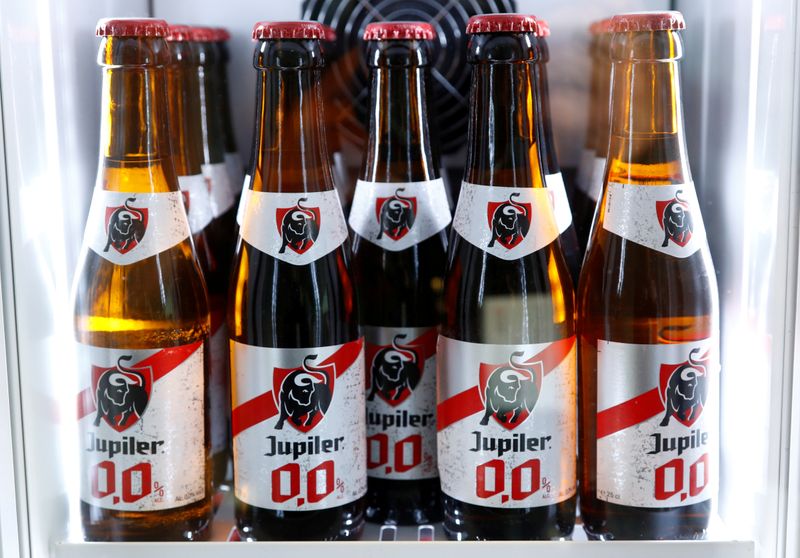
Anheuser-Busch InBev posted Q1 underlying EPS of $0.97, up 21% year over year and above $0.89 consensus, with organic revenue rising 5.8% versus 3% expected and organic EBITDA up 5.3% versus 2.6% expected. Beer volumes increased 1.2%, gross margin expanded 76 bps to 56.6%, and the company maintained 2026 EBITDA growth guidance of 4% to 8%. AB InBev also completed $1.4 billion of its $6.0 billion buyback and saw Moody’s upgrade its credit rating to A2 from A3.
The key signal is not simply a beat; it is that AB InBev is showing pricing power, mix improvement, and volume resilience at the same time, which is rare in mature consumer staples. That combination usually marks an inflection where earnings revisions can stay positive for several quarters even if category growth slows, because gross margin expansion creates operating leverage that consensus models often underwrite too conservatively. The upgrade to A2 and ongoing buyback also matter: lower funding friction plus repurchases can amplify equity upside even if top-line momentum normalizes.
The weakest link is China, but the more interesting second-order effect is what that implies for global brewer positioning. AB InBev is effectively choosing to spend into a soft patch to defend long-term share, which could force competitors with weaker balance sheets to either follow on marketing or accept share loss; that tends to pressure mid-tier regional brewers before it shows up in headline industry volumes. The market may also be underestimating the BEES ecosystem: if marketplace take-rate and data monetization continue scaling, this becomes a higher-quality route to recurring revenue than traditional beer distribution.
The main risk is that investors extrapolate too much of the margin beat into a straight-line upgrade story. A stronger peso/real and any reversal in freight or commodity input trends could blunt near-term EBITDA momentum, while a broader consumer slowdown would hit premium brands first after the initial elasticity cushion fades. Horizon-wise, this is a months-long earnings revision story, not a one-day tape story; the next catalyst is whether management can convert strong first-quarter execution into a raised full-year target or incremental buyback acceleration.
Consensus is likely still anchoring on AB InBev as a low-growth staples name, when the cleaner read is that it is becoming a cash-return compounder with selective growth pockets. The market may be underpricing the optionality from non-alcohol, beyond beer, and digital commerce, which can add mix and reduce dependence on volume. If those franchises keep compounding, the stock deserves a rerating versus global beverage peers with weaker balance sheet flexibility and less visible capital return support.
AI-powered research, real-time alerts, and portfolio analytics for institutional investors.
Request DemoOverall Sentiment
strongly positive
Sentiment Score
0.72
Ticker Sentiment
