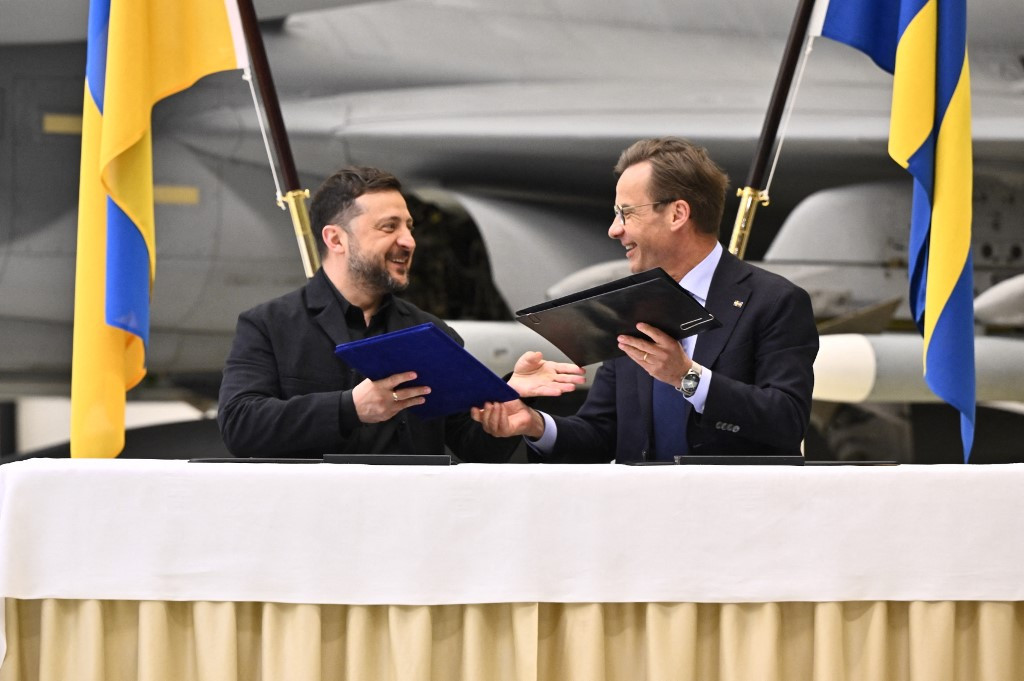
Sweden will transfer 16 Saab Gripen C/D fighter jets to Ukraine for free and Ukraine will buy 22 additional Gripen E aircraft, with deliveries starting in 2027 and the first jets expected within 10 months. The package also includes weapons, including missiles with ranges above 200 kilometers, strengthening Ukraine’s air defense and long-term fighter fleet modernization. The deal is strategically significant for Sweden, Saab, and Ukraine, but it is not an immediate broad market event.
This is less a one-off headline than an acceleration signal for a multi-year European airpower rearmament cycle. The immediate winner is Saab’s industrial moat: even if the Ukraine package is partially concessional, it validates the Gripen as the cheapest credible Western fighter for dispersed operations, which matters for every mid-sized air force that cares about runway resilience, maintenance burden, and sortie generation. The second-order effect is on the entire Nordic/European defense supply chain: missiles, sensors, EW, MRO, and training systems now become the larger near-term monetization pool than airframes themselves.
The market is likely underestimating the option value of a follow-on order cascade. If Ukraine meaningfully operationalizes Gripen in combat, the sales pitch to Eastern European and Asian buyers shifts from “good in theory” to “combat-proven in high-attrition conditions,” which can compress procurement timelines by 12-24 months. That would also crowd out some F-16 incremental demand at the margin, especially for countries that prioritize survivability from austere bases over NATO commonality.
Key risk is financing and execution, not geopolitics. The first deliveries are the real catalyst window: anything that slips beyond 6-9 months would weaken the narrative and reduce the probability of follow-on tranches. There is also a substitution risk: if Western air-defense and long-range missile inventories improve faster than fighter procurement, the perceived urgency for new airframes could fade, limiting upside to Saab’s order book and pushing the value capture toward missile suppliers instead.
Contrarian view: the market may be overpaying for the headline and underpricing the fact that defense procurement still clears on budgets, not sentiment. The best trade is not a blind long on the airframe manufacturer alone, but a basket tilted to the consumables and electronics that scale with sortie tempo and fleet support. If Ukraine’s program is funded but phased, the earnings uplift is likely smoother and more durable for subsystem suppliers than for the prime contractor.
AI-powered research, real-time alerts, and portfolio analytics for institutional investors.
Request TrialOverall Sentiment
moderately positive
Sentiment Score
0.62
