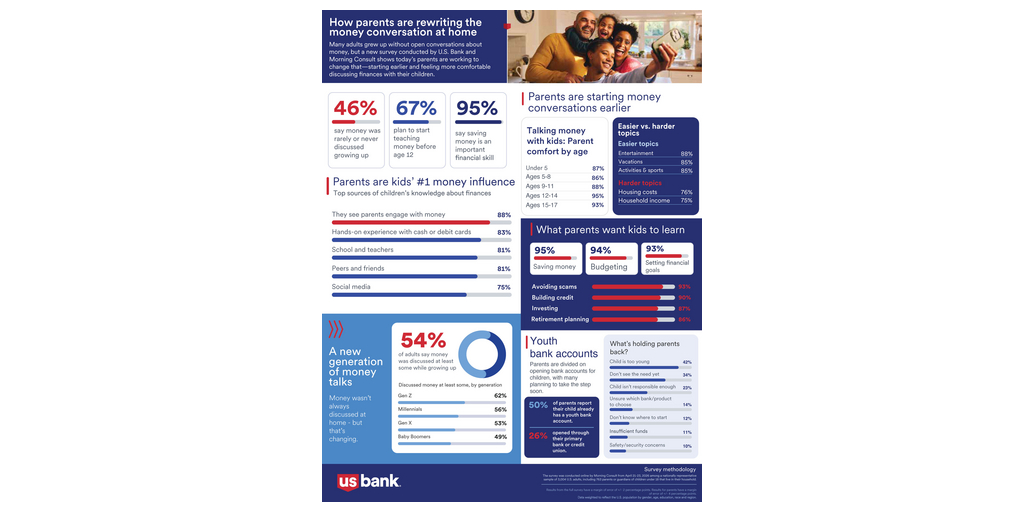
U.S. Bank and Morning Consult survey (3,004 U.S. adults) finds 67% of parents discuss money before age 12, with nearly 9 in 10 parents saying they feel comfortable doing so and that kids should learn to save, budget, and set goals. However, only about half have opened a youth bank account, citing uncertainty (about a quarter say their child isn’t ready; 1 in 10 don’t know where to start). U.S. Bank highlighted its partnership with Greenlight to close the intent-to-action gap, offering complimentary access ($69 annual value) for eligible checking customers.
This is not a near-term earnings event; it is a distribution signal. The economic value to USB is less about the youth account itself and more about lowering customer-acquisition cost for a future primary-banking relationship: if the family becomes embedded early, the bank can potentially capture checking, cards, and eventually lending when the child ages up. That makes the upside long-duration, but the near-term P&L contribution is likely immaterial unless management can show measurable conversion into funded accounts and retained deposits.
The more interesting second-order effect is competitive positioning versus JPM, BAC, and WFC: the winner is whichever bank turns a “nice-to-have” family app into a habit-forming interface. Greenlight is the visible partner, but the real moat is customer habit and parent control, not card rails; MA gets only modest incremental transaction volume unless this scales materially across bank partners. If adoption stays shallow, the product becomes a marketing expense with limited balance-sheet benefit and some servicing/compliance overhead.
The key risk is intent/action mismatch. Parents may like the concept but fail to complete onboarding, so the metric to watch over the next 1-2 quarters is not survey sentiment but actual linked-account activations, average funded balances, and retention into the core USB relationship. Falsifiers: no lift in digital engagement or youth-account openings by next earnings, or evidence the feature is being used mostly as a free perk rather than a deposit-gathering funnel. Over 6-18 months, the thesis only matters if USB proves it can convert family engagement into stickier deposits and lower churn than peers.
AI-powered research, real-time alerts, and portfolio analytics for institutional investors.
Request DemoOverall Sentiment
mildly positive
Sentiment Score
0.12
Ticker Sentiment
