







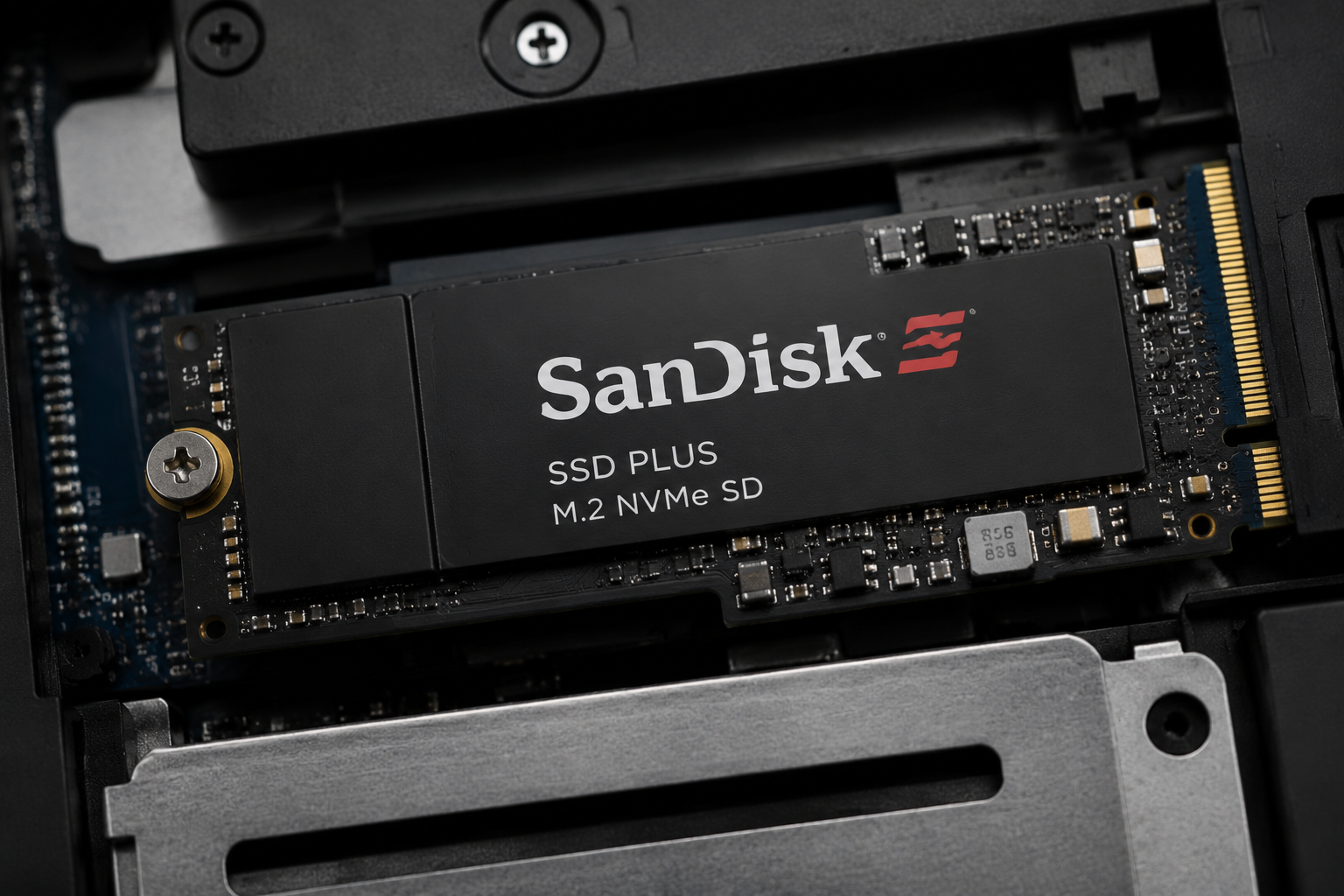
SanDisk (SNDK) is down sharply—down ~35% from its YTD high and trading near a key chart level after a selloff into the 38.2% Fibonacci retest and below the 50-day moving average. Fundamentals cited are strong: prior-quarter revenue rose to $5.95B (from $1.69B YoY) with nine-month revenue at $11.28B, supported by multi-year contracts and elevated hyperscaler demand (Apple/Microsoft/Amazon/Google). Despite bullish analyst targets (average price target $1,803 vs $692 three months ago), the article frames near-term technicals as bearish with a downside target around the 50% retracement near ~$1,200, warning that any memory pricing/demand reversal could quickly hit margins.
Near term, this is more a positioning/flow story than a clean fundamentals break. The group trades like a leveraged proxy on hyperscaler confidence, so any sign of slower capex from MSFT/AMZN/GOOGL can hit MU/WDC first through multiple compression, even before earnings estimates move. SNDK’s contract mix should make it less fragile than spot-exposed peers, but the market will still punish it if investors decide the current earnings rate is peak-cycle rather than sustainable.
The main second-order risk is that high memory prices feed back into cloud economics: if component costs stay elevated, server deployment economics deteriorate and customers stretch purchases, which would eventually pressure the whole complex. Conversely, if pricing softens, buyers like AAPL/MSFT/AMZN/GOOGL get a margin tailwind, but that same dynamic usually signals the industry is moving from shortage pricing toward inventory normalization. In that scenario, MU and WDC typically absorb the downside first because their earnings are more sensitive to spot pricing and capex discipline.
Time horizon matters: over days, technicals can keep driving SNDK lower simply because it broke trend support and sits in a crowded trade. Over 1-3 months, the key catalyst is hyperscaler commentary and next memory earnings/guide, which will tell us whether this is a pause in an upcycle or the first leg of a reset. Over 6-18 months, the market will re-rate these names based on whether contract coverage truly reduces cyclicality or just delays the inevitable inventory correction.
The consensus may be underestimating how quickly a "cheap" forward multiple in memory can become a value trap if peak earnings are being capitalized. I would want to see sustained upward revisions in contract-backed gross margin before assuming SNDK deserves a premium to MU/WDC; otherwise, the current debate is mostly about how far the cycle has already run, not about long-term secular growth.
AI-powered research, real-time alerts, and portfolio analytics for institutional investors.
Request TrialOverall Sentiment
mildly negative
Sentiment Score
-0.25
Ticker Sentiment
