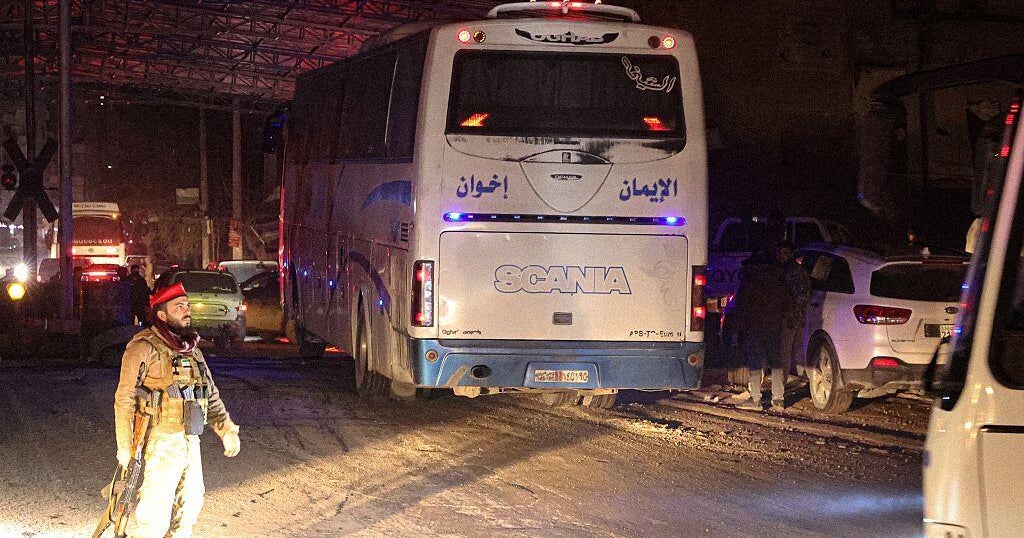
Kurdish fighters were evacuated from Aleppo's Sheikh Maqsoud after days of intense clashes with Syrian government forces; officials said buses carried 360 fighters as state media reported at least 22 killed and more than 140,000 displaced over five days. Drone strikes prompted a temporary halt to flights at Aleppo International Airport, government forces captured Achrafieh and Bani Zaid, and U.S. envoy Tom Barrack held talks urging a ceasefire even as the U.S. conducted large-scale strikes on Islamic State targets—developments that heighten regional security risk and political uncertainty for investors exposed to Syria and neighboring markets.
Market structure: Immediate winners are defense contractors (LMT, RTX, GD) and safe-haven assets (GLD, TLT, USD) as risk-off flows reprice geopolitical premia; energy producers (XOM, CVX, XLE) are potential beneficiaries if the conflict broadens and Brent rallies 2–5% in days and >10% in a spillover. Losers are EM sovereign debt and regional service sectors (airlines AAL/UAL, tourism-exposed stocks) as spreads and FX weakness pressure financing costs. Supply/demand: Syria itself is immaterial to crude supply, so moves will be driven by risk premium and shipping/insurance costs, not fundamental barrels — expect volatility, not a sustained supply shock unless Iran/Turkey enter directly.
Risk assessment: Tail risk is a regional escalation (low probability, high impact) that pushes Brent >$100 (+15–30%), global risk-off and a 50–150bp widening in EM CDS; this could occur within days-weeks if Iran/Turkey intervene. Short-term (0–30 days) expect flight-to-quality and FX/EM pain; medium term (1–6 months) watch for policy responses and oil-driven inflation re-pricing; long-term (6–24 months) reconstruction and defense budgets could reallocate capital. Hidden dependencies include refugee flows, sanctions rotation, and concurrent US strikes against ISIS — any of which can amplify contagion; key catalysts to monitor are Iranian state statements, Turkish cross-border moves, and Brent >$95 or EMB spread widening >100bp.
Trade implications: Tactical plays: short-duration safe-haven longs (GLD, TLT) and tactical long-defense and energy exposure, balanced with EM debt hedges. Use options to cap downside: buy 1–3 month Brent call spreads (BNO/CL) sized 0.5–1% portfolio for a +8–15% Brent move, and 3–6 month call spreads on LMT/RTX (10% OTM) sized 1–2% total for asymmetric upside if defense re-rating continues. Reduce outright EM sovereign exposure (trim EMB by 30–50%) and replace with CDS protection or inverse EM ETFs; enter within 48–72 hours, reassess after 30 days or if ceasefire holds.
Contrarian angles: Markets may overprice contagion — historical parallels (2013 Syria flare-ups) show sharp short-lived oil spikes and rapid mean-reversion once no regional powers engage; therefore avoid large directional corps exposure without hedges. Mispricing opportunity: if EMB spreads widen >150bp, selectively buy longer-dated EMB tranches for carry with strict stop-loss (20–25%) as policy support typically returns within 3–6 months. Unintended consequence: a persistent oil premium could accelerate US shale capex response within 6–12 months, capping long oil exposures — favor options and small sizing rather than large outright longs.
AI-powered research, real-time alerts, and portfolio analytics for institutional investors.
Request DemoOverall Sentiment
strongly negative
Sentiment Score
-0.60
