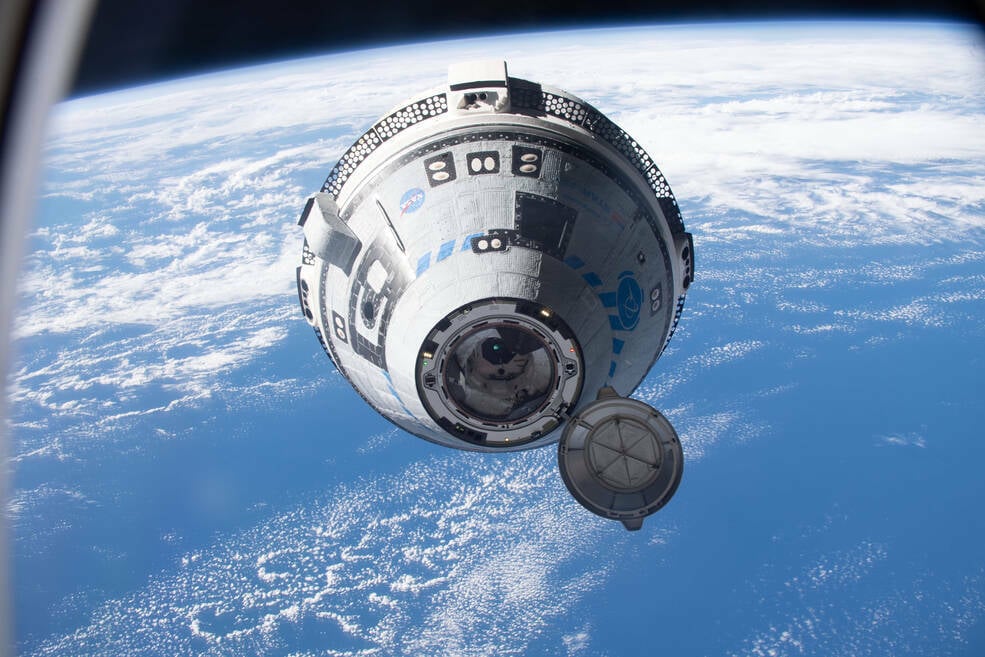
NASA has amended its Commercial Crew contract with Boeing, reducing the planned Starliner missions from six to four (one uncrewed) and delaying the uncrewed Starliner‑1 flight until no earlier than April 2026. The change follows a 2024 test‑flight failure that left astronauts aboard the ISS and prompted in‑flight validation of propulsion and other upgrades; Boeing originally bid $4.2bn for the contract (SpaceX bid $2.6bn). With up to three crew rotations now possible under the modified contract and options for two more, the decision compresses Boeing's near‑term revenue visibility, raises certification and execution risk, and keeps program economics and competitive positioning under pressure through 2030.
Market structure: NASA’s cutback converts a multi-year revenue and credibility hit for BA into an immediate loss of pricing power and schedule optionality. SpaceX (private but effectively the default NASA partner) will likely take the marginal missions and pricing leverage in 2024–2026; expect Boeing’s share of NASA commercial crew rotations to be <40% through 2026, pressuring BA Commercial Services revenue and tying margin recovery to certification milestones rather than demand growth.
Risk assessment: Near-term (days–weeks) the stock should remain sensitive to headlines and implied volatility; short-term (1–6 months) earnings/CF will reflect postponed revenue and potential charge reserves; long-term (1–3 years) BA’s downside paths include further contract reductions, FAA/NASA sanctions, or cost-overruns that materially widen credit spreads. Tail risks: failed re-test in 2026, NASA contract cancellation, or a surprise ISS life-extension cut (to <2028) that removes even the truncated flight window.
Trade implications: Preferred tactical actions are asymmetric hedges: protect equity risk with 3–9 month put protection (buy 6‑month BA puts sized 1–2% portfolio) and implement a relative-value pair—short BA vs. long RTX or LMT (equal notional, 6–12 month horizon) to capture capture-share reallocation and defense-stable cash flows. Credit: consider small long protection in BA 3-year CDS or underweighted corporate bond puts if spreads widen >75bp above current levels.
Contrarian angles: Consensus underestimates BA’s defense backlog and aftermarket services resilience; if Starliner fixes validate by mid-2026 and NASA confirms station operations to 2030, BA equity could retrace sharply. Position sizing should be phased: initial defensive hedges now, add constructive exposure only on a successful NASA certification milestone (e.g., Starliner-1 uncrewed launch after Apr 2026) or if BA reports buyback reinstatements/positive guidance restoring free cash flow visibility.
AI-powered research, real-time alerts, and portfolio analytics for institutional investors.
Request DemoOverall Sentiment
moderately negative
Sentiment Score
-0.50
Ticker Sentiment
