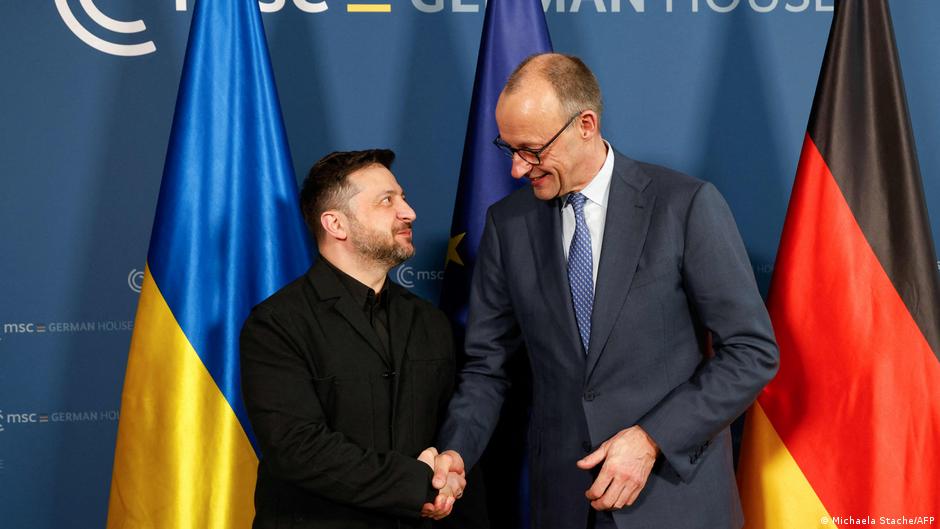
Germany's Chancellor Friedrich Merz proposed an "associate member" EU status for Ukraine, giving Kyiv access to EU summits, ministerial meetings, mutual assistance protections and some budget funding, but without voting rights. The plan is meant as an interim step toward full membership and could include a snap-back mechanism if Ukraine backslides on rule-of-law standards. The proposal highlights the EU's struggle to balance support for Ukraine with the lengthy, politically complex accession process.
This is less a headline about accession mechanics than a signal that the EU is moving toward a two-speed enlargement regime. That matters because it reduces the probability of a hard binary outcome for Ukraine-related assets: instead of waiting for a full ratification endpoint, markets can begin discounting incremental institutional integration, budget access, and legal protections over the next 6-18 months. The first-order beneficiaries are Ukrainian sovereign risk, local infrastructure/defense contractors, and any private capital that was previously waiting for a cleaner policy umbrella before committing.
The second-order effect is on Central and Eastern Europe incumbents: a quasi-member Ukraine would pull forward competition for reconstruction capital, labor, and EU fiscal attention. Poland, Romania, and Baltic logistics/engineering firms could see medium-term upside from transit, warehousing, and border infrastructure, but Western Balkan accession candidates may face further relative disappointment if Brussels proves willing to invent interim status for Ukraine while their own timelines remain stalled. That creates a wider dispersion trade within European frontier and semi-core baskets rather than a simple “Ukraine up, everyone else flat” setup.
The main risk is that this is politically elegant but operationally fuzzy; if Kyiv is left in a limbo structure with no credible path to full voting rights, the market could quickly reprice the announcement as symbolism rather than capital formation. Near term, the catalyst path is European summit language and whether budget/legal carve-outs become enforceable rather than aspirational. Over 3-12 months, the key reversal trigger is a renewed veto dynamic from member states, especially if rule-of-law conditionality or war fatigue hardens into a delay narrative.
Consensus is likely underestimating how much this helps de-risk reconstruction financing without requiring a ceasefire first. If the proposal gains traction, the real winners may be not sovereign bonds alone but contractors and banks that can underwrite cross-border capex with lower political risk premia. The move may also be overdone in terms of timing for full membership, but underdone for interim capital flows and procurement acceleration.
AI-powered research, real-time alerts, and portfolio analytics for institutional investors.
Request DemoOverall Sentiment
neutral
Sentiment Score
0.10
Ticker Sentiment
